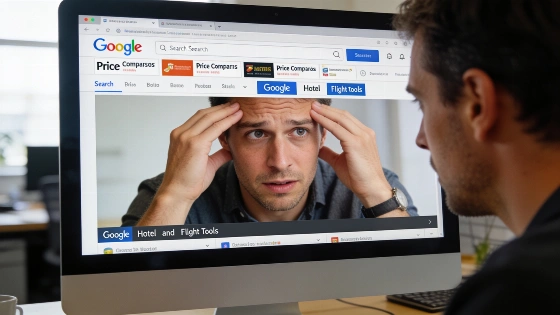
Google’s search results in Europe have changed sharply after a $534 million EU antitrust fine. The company has pulled back its own hotel and flight tools from the top of results, giving more space to price comparison sites and pushing Google’s features further down the page. Executives now admit these changes have caused the biggest drop in search quality since Google launched, with users forced to click through more third-party sites and local businesses losing direct exposure.
In the new European search results, Google now gives more space to vertical search services and aggregators like Expedia and Booking.com, rather than direct hotel and airline websites.
Sports publishers are also losing ground. Google’s latest update adds a real-time Live Game Feed to NFL search results, with play-by-play cards, video highlights, and social commentary. On mobile, the feed takes up several scrolls, pushing publisher content further down and making it harder to get clicks. Even the new fantasy sports integration-letting users sync Yahoo Fantasy and Sleeper accounts for AI-driven lineup advice-has had technical issues and limited usefulness so far.
AI competition and platform lockdown
OpenAI has started blocking ads for standalone image and audio generation tools inside ChatGPT, just as it launches its own Images 2.5 and Live voice features. Adobe, which was part of OpenAI’s ad pilot, can no longer promote its creative tools on the platform. The move comes as OpenAI tries to keep users inside its own ecosystem and monetize its generative products, limiting competitors’ reach as user numbers climb.
Google described the changes to its European search results as the largest reduction in quality of service in its 29-year history, with hotel, airline, and restaurant carousels now appearing lower on the page and missing key features like real-time prices.
AI everywhere and the Gemini push
Google is still expanding its AI offerings. The Gemini desktop app is now available for Windows 10 and 11, with instant access via Alt + Space and deep integration with Google Workspace. Users can draft documents, manage workflows, and generate AI images or videos directly from their PC. This follows Google’s recent decision to retire Google Assistant on Android, as previously reported, marking a full shift to Gemini as the main AI platform across devices.
For newsrooms and digital publishers, the message is clear: easy search traffic is gone. Google’s changes to comply with EU rules have made the user experience worse for millions, but the company is willing to accept that rather than give up market control. OpenAI’s ad restrictions and Anthropic’s warnings show an industry where platform control and regulation now shape product decisions. Publishers who don’t build direct relationships with their audiences or adapt to AI-driven interfaces will keep losing ground, as clicks and visibility are pulled away by the same platforms that once drove their growth.
Google, founded in 1998, is still the world’s leading search engine, handling over 8.5 billion searches per day as of 2026. Its parent company Alphabet reported $307 billion in revenue last year, with search and ads making up more than half. The EU’s Digital Markets Act, which led to these changes, targets tech giants with annual revenues above €7.5 billion and at least 45 million monthly active users in the EU, aiming to limit self-preferencing and restore competition in digital markets.