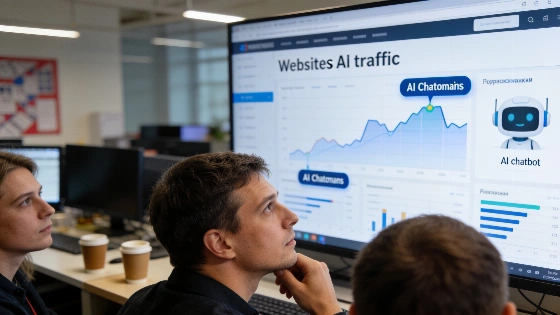
AI chatbots like ChatGPT, Perplexity, and Gemini now surface more links to news sites, but the traffic they send is still a drop compared to what search engines once brought in. Most publishers hoping for a flood of new readers from these bots end up disappointed. The real question is not how to squeeze more visits out of AI, but how to make each one matter-and why newsrooms need to overhaul how they track and capture value from this new source.
For news-related queries, about 69% of search sessions end without a click to an external site, highlighting the rise of so-called 'zero-click' results as search engines answer directly on the results page.
Counting raw pageviews from AI sources leads nowhere. What matters is value per visit. Set up goals in your analytics-newsletter signups, paid subscriptions, Telegram channel joins-and compare how often AI, search, and social visitors convert. If AI users sign up or subscribe at rates like those seen by Le Monde and Microsoft Clarity, the channel is worth the effort, even if the numbers are small. If not, that’s a clear signal too.
Access and control
AI bots get to your content based on what’s in your robots.txt file. OpenAI, for example, uses GPTBot for model training, OAI-SearchBot for ChatGPT search indexing, and ChatGPT-User for visits triggered by users. Blocking GPTBot won’t remove your site from ChatGPT search, but blocking OAI-SearchBot will. The OpenAI Help Center spells it out: only by blocking OAI-SearchBot can you keep your site out of ChatGPT search results, while GPTBot just controls data collection for training. Yandex uses YandexAdditionalBot for Alice AI answers. Google is testing opt-outs for AI Overviews in the UK through Search Console, but this doesn’t affect classic search rankings. Blanket blocking doesn’t work as expected. HasData found that 56.4% of news domains block at least one AI bot, but 39.5% of those still serve pages to GPTBot. Reuters and Time only allow select bots. Shkulev Media Holding in Russia ran a live test, blocking YandexAdditional, GPTBot, and ChatGPT-User on some sites to see what changed.
OpenAI states that sites allowing OAI-SearchBot can track ChatGPT referrals in analytics systems, as ChatGPT automatically appends the parameter utm_source=chatgpt.com to outbound links.
Optimizing for AI discovery
Some static or commercial sites try using llms.txt files-summaries for AI bots-but Ahrefs found that 97% of these files got zero requests in May 2026. For Alice, data from “Ашманов и партнёры” shows that ranking high in search is still the main way to get into AI answers. That means fast-loading pages, clear text, strong headlines, dates, and bylines still matter. Yandex says Alice picks sources based on expertise, usefulness, originality, and substance.
AI chatbots don’t scan whole sites. Each answer comes from a single article, so every news story needs to be optimized on its own. Platforms like Give Me Feed now offer editorial AI tools to prep each article for generative engine discovery, including schema.org markup in the page head. This markup tells bots what the article is, when it was published, who wrote it, and what it’s about-removing technical barriers to showing up in AI answers. Still, neither text tweaks nor markup guarantee selection, but they do clear away avoidable roadblocks.
Content that demands a click
AI chatbots are great at summarizing generic news, reference guides, and evergreen explainers. That leaves users with little reason to click through. Chartbeat data shows news sites get the most AI-driven views in total, but engagement per article is the lowest of any category. Reuters Institute reports that newsroom leaders are scaling back on service journalism and generic news, and instead putting resources into original investigations, on-the-ground reporting, and unique data or interactive tools. The only content that reliably gets AI users to click is what can’t be paraphrased: exclusive data, local reporting, live coverage, or interactive features like calculators and maps. If your article doesn’t solve a problem the AI can’t, the click won’t come.
Building direct relationships with readers is now essential. As AI changes interfaces and search platforms hide more links, loyal visitors become the only steady traffic source. Chartbeat’s network saw internal navigation rise from 38% of views in 2024 to 41% by late 2025, making internal links the top traffic driver for news sites. Newsletters, registrations, messenger channels, and apps all help turn one-off visitors into regulars. AI-driven visitors, who often convert better than others, should see subscription offers first.
Quarterly reality checks
AI referral traffic swings wildly. One outlet might double its ChatGPT visits in three months, while another loses half. Every quarter, export your AI traffic share, top articles, and conversion rates. After a year, you’ll have your own dataset-maybe even the first public Russian case study. Search won’t return to its old scale, and AI won’t fully replace it. But every reader who arrives via AI is now more valuable than before.
The hard truth is that chasing AI traffic volume leads nowhere. The real contest is for reader intent: giving people a reason to click, and a reason to stick around. Newsrooms that just rewrite the news will compete with bots that summarize for free, instantly, and inside the answer box. Those who deliver what AI can’t will win not just a small but high-value audience, but also the loyalty of the readers who matter. Setting up analytics takes an evening. Finding your unique value takes longer, but that’s where the payoff is.