
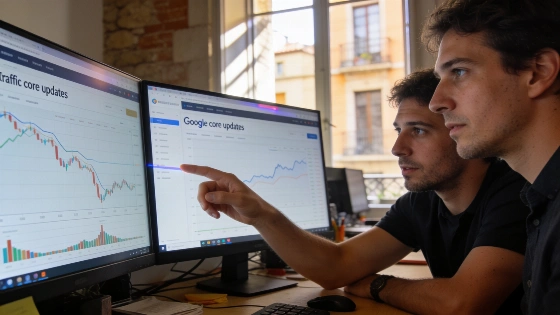
Sites hit by a Google core update can sit in limbo for half a year. Some never claw their way back. At Search Central Live Deep Dive Europe 2026 in Barcelona, Google’s own slides confirmed what many have guessed: the company’s quality systems can keep a domain suppressed for months, sometimes for good, if the content falls short of shifting standards.
In October 2026, Google updated its helpful content guidelines to specifically highlight the main content of a page-elements that directly help fulfill its purpose. This was a documentation change, not a new algorithm or ranking formula.
For publishers, the four pillars-effort, originality, talent or skill, and accuracy-are operational. Google measures them. The May 2024 Content Warehouse API leak exposed fields like contentEffort and OriginalContentScore. These fields estimate how much human work went into a page and whether it brings anything new. Pages mass-produced, AI-generated without review, or echoing existing material get flagged as “commodity content.” That’s a ranking death sentence.
Quality Signals Rewrite the Index
Google’s index doesn’t just store pages. Every URL carries a quality score, set before a search even runs. When someone types a query, Google pulls candidates and sorts them by language, country, and quality. If a site’s reputation drops, its pages might not even reach the ranking stage. Gary Illyes has said core updates work at the page level, but site-level signals like siteAuthority, siteFocusScore, and pandaDemotion can drag down every page on a domain.
Google’s updated guidelines emphasize that mass generation of text using AI without human review is considered low-effort content. Simply citing other sources does not substitute for original contribution.
Google’s internal systems, including Q* (Qstar), assign a static quality grade to each page. This grade shapes crawl frequency and eligibility for rich results. Twiddlers-algorithmic adjustment layers-can boost or demote results based on spam signals or host age. The process never stops. In 2023, Google ran over 719,000 quality tests and nearly 17,000 live traffic experiments to tune these systems.
AI Content and the Commodity Trap
AI hasn’t rewritten the rules, but it’s made breaking them easier. Google’s guidelines spell it out: “the use of Generative AI tools alone does not determine the level of effort or Page Quality rating.” Still, AI enables mass production of bland, interchangeable content-the exact target of the four pillars. The latest documentation singles out fake authorship and credentials as explicit low-quality signals.
Large publishers face constant temptation. Open a new category, launch thousands of “what is X” pages, or translate content into more languages, and traffic might spike-until a core update lands. The Softonic case shows the risk: merging languages under one domain triggered a 20% traffic drop after a core update. Lower-quality translations dragged down the site’s reputation. Only by splitting languages onto separate ccTLDs and focusing on quality did Softonic recover and surpass old traffic levels.
Google’s approach to AI Overviews and AI Mode is just as strict. There’s no secret markup or llms.txt file to game the system. Commodity content loses across every query the model touches. Only unique and useful pages win citations in generative search features.
Recovery Timelines and Operational Reality
Publishers hoping for a quick bounce after cleanup face a long wait. Google’s slides, photographed by Estela Franco, show sitemap processing can take up to 14 days or never for low-quality sites. Indexing can stretch to months or not happen at all. Structured data updates may sit for weeks or be ignored if quality is lacking. The documentation is clear: recovery “could mean waiting until the next core update.”
For sprawling sites, the operational checklist is direct. Group URLs by page type and check traffic, indexed percentage, and growth. Flag page types with high “Crawled - currently not indexed” rates. Run every page type through the four pillars: real human effort, unique value, subject-matter expertise, and factual accuracy. If a page falls short, improve, consolidate, or remove. Progress is measured in months.
Google’s grip on search and digital advertising, detailed in a recent report, means a site’s fate can hinge on signals invisible to most publishers but enforced by the algorithm. In a world of 20,000 oranges, only the one with real flavor gets picked.
Publishers who treat quality as a checklist or chase scale with AI shortcuts lose ground. The only path forward is content that shows unmistakable human effort, originality, and expertise-page by page and section by section. Anything less, and the filter catches you before you even start.








