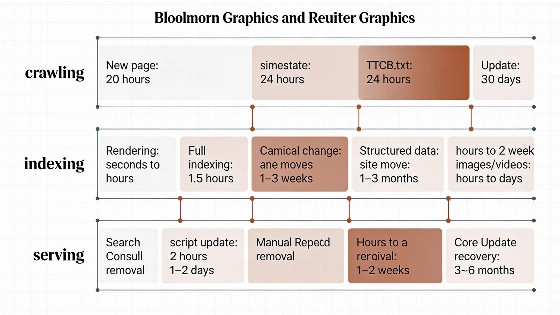
It’s no longer a guessing game. Google has released exact numbers on how long it takes for new and updated web pages to show up in search. Estela Franco shared the data at Search Central Live Deep Dive Europe in Barcelona. This is the first time Google has given such a detailed look at its search pipeline. The company rarely shares this level of detail.
Google distinguishes between discovery, crawling, rendering, and indexing as separate steps, each with its own timeline and technical triggers.
Indexing isn’t simple either. After a page is crawled, rendering can take seconds or stretch to several hours. It depends on how complex the page is. Full indexing averages 1.5 hours. But big changes-like removing a page or changing a canonical URL-can take one to three weeks. Moving an entire site? That’s slow. Google says a site migration can take one to three months before it’s fully processed. Their technical docs confirm it: canonical changes need 1-3 weeks, and site moves can take up to three months to show in search.
Images and videos don’t move faster. They may need several hours or even days to get indexed. Structured data updates can take a few hours or up to two weeks to appear in search. The crawl rate itself isn’t fixed. Google can adjust how often it crawls a site in as little as four hours, or it might take two weeks. It depends on server signals and site health. PPC Land reports that fixing crawl issues can take up to 1-3 weeks. That’s why some sites see long delays while others don’t.
Google has clarified that submitting a sitemap or requesting a recrawl does not guarantee immediate indexing or even crawling of all URLs. The process remains subject to internal prioritization and technical constraints, which can lead to significant variability in actual wait times.
This news comes as AI-driven content and real-time search are changing how publishers work. Google’s Gemini 3.8 Live is already pushing instant answers and voice search in many languages. But the core crawl and index system still runs on these measured, sometimes slow, cycles.
For SEOs and publishers, these numbers aren’t trivia. They’re the rules of the game. Updating content just before a launch or news event won’t guarantee fast visibility. The data is clear. Even with AI and automation, Google’s search engine works in deliberate, staged steps. Those who plan for these waits will beat competitors who guess or rely on old assumptions. Every hour of search visibility can mean thousands in ad revenue or lost audience. Knowing the real wait times is now a real edge.
Google Search has been around since 1997. It handles billions of queries every day. It’s still the top search engine worldwide, with over 90% market share in most places. Google keeps investing in AI and infrastructure. That’s how we get instant voice answers and real-time indexing for some content. But the main crawl and index pipeline still runs on the schedules revealed in this new data. Some things don’t change fast.