
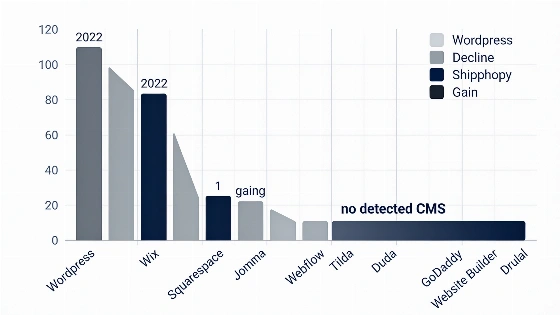
WordPress appeared on 39.2% of all surveyed websites on Nov. 13, down from 43.2% at its January 2022 peak. W3Techs’ statistics put its share of websites with a detected CMS at 57.9%, down from approximately 65.2% in January 2022 and its lowest level since 2013. The two percentages use different denominators: all-site usage includes websites for which no CMS was detected, while CMS market share is calculated among sites with a detected CMS.
The shift extends beyond WordPress. Shopify’s share of the known-CMS market reached 7.9%, while the proportion of sites with no detected CMS climbed to 32.3%. W3Techs reported that 67.7% of surveyed sites had a detectable CMS. The no-detected-CMS category does not necessarily mean a site has no content-management system; a custom, proprietary, obscured or unrecognized system may not be detected. The figures describe changes across W3Techs’ survey; they do not show which sites switched platforms or why.
How the market shifted
W3Techs reported that 67.7% of websites use a CMS. Netcraft reports more than 323 million domains; applying the W3Techs percentage produces an estimated 218.8 million websites using a CMS. The figure is an approximation based on the two sources, not a direct count of CMS-equipped sites.
PlatformMarket shareAll-site usageEstimated sitesAll monitored CMS | N/A | 67.7% | 218.8 million
WordPress | 57.9% | 39.2% | 126.7 million
Shopify | 7.9% | 5.4% | 17.4 million
Wix | 6.2% | 4.2% | 13.6 million
Squarespace | 3.6% | 2.4% | 7.8 million
Estimated site counts extrapolate from W3Techs and Netcraft data. Market share uses sites with a known CMS as its denominator; usage measures a platform’s share of all surveyed websites. The distinction matters: a platform’s market-share percentage can rise even when its all-site usage is unchanged. WordPress’s 39.2% all-site usage is consistent with its 57.9% share of detected CMSs and the 67.7% of sites for which W3Techs detected a CMS, subject to rounding.
In W3Techs’ Nov. 13 ranking, WordPress led at 57.9% of known-CMS sites, followed by Shopify at 7.9%, Wix at 6.2% and Squarespace at 3.6%. Joomla had 1.6%; Tilda and Webflow each had 1.2%. Duda registered 1.1%, while GoDaddy Website Builder and Drupal each stood at 0.9%. These percentages measure the distribution among sites where W3Techs detected a CMS, not platform revenue, customer counts or installed instances. The 32.3% of surveyed sites with no detected CMS sits outside that ranking.
Leaders and holdouts
WordPress usage across all sites rose from 23.3% in January 2015 to 43.2% in January 2022, then fell to 39.2% in the latest snapshot. Since Jan. 1, 2026, its known-CMS share moved from 60.2% to 57.9%; all-site usage fell from 43.0% to 39.2%. WordPress’s known-CMS share had also dipped below 60% in 2016, 2017 and 2019. The data tracks adoption, not the reasons individual sites changed or whether they changed at all.
Shopify’s market share increased from 7.0% at the start of 2026 to 7.9%, while all-site usage rose from 5.0% to 5.4%. Wix’s market share grew from 5.8% to 6.2%, though its all-site usage remained 4.2% at the displayed precision. Squarespace’s known-CMS share grew from 0.5% in January 2015 to 3.6%; its current all-site usage is 2.4%.
Year over year, from November 2025 to November 2026, Shopify gained 1.1 percentage points, or 16.2%; Wix gained 0.5 points, or 8.8%; Squarespace added 0.2 points, or 5.9%. Shopify’s growth rate was 4.6% in the prior reported period, when Wix grew 32.6% and Squarespace 9.7%. The figures describe relative market-share growth, not a measure of site performance.
Joomla’s share dropped from 2.5% in January 2024 to 1.6% in November 2026; Drupal’s fell from 1.6% to 0.9%. Since January 2015, Joomla declined from 8.6% and Drupal from 5.1%. They have moved from second and third place to fifth and tenth. Google Trends data cited in the report shows Joomla briefly surpassing WordPress in search interest until around 2008; Shopify has since overtaken WordPress in search interest. These are search-interest comparisons, not CMS usage measurements.
The no-detected-CMS category increased from 28.6% on Jan. 1, 2026, to 32.3% on Nov. 13, while WordPress usage fell from 43.0% to 39.2%. W3Techs’ category means no monitored CMS was detected; it does not establish that a site is custom-coded or that its owner abandoned a CMS. A decline in WordPress’s measured share therefore does not, by itself, identify a corresponding migration to another named platform.
Plugins and stores
Elementor, a WordPress page-builder plugin rather than a standalone CMS, appeared on 18.2% of sites with a known CMS and 12.3% of all sites surveyed. Its usage overlaps with WordPress and should not be added to WordPress’s figures. W3Techs’ traffic-rank comparisons use each ranking tier’s known-CMS sites as the denominator; they show Drupal more represented among highly ranked sites than its overall footprint would suggest, while Wix and Squarespace have lower representation in top-ranked groups. That comparison does not measure business size or software quality.
WooCommerce also sits within the WordPress ecosystem. It appeared on 11.4% of websites with a known CMS and 7.7% of all surveyed sites, compared with Shopify’s 7.9% and 5.4%, respectively. W3Techs’ separate ecommerce-system survey uses a different denominator: websites using an ecommerce system it monitors. On that measure, WooCommerce had 47.0% and Shopify 32.7%; these are not sales or revenue shares and do not represent every online store.
Within the known-CMS comparison, WooCommerce’s 11.4% exceeds Shopify, PrestaShop at 0.7% and OpenCart at 0.4% combined. Shopify has a stronger presence in several higher-ranked site groups, despite WooCommerce’s larger overall share. Shopify’s market share grew 52.9% from 2020 to 2021 and 26.9% from 2021 to 2022; after a dip in 2023, it recovered in 2024 and reached 7.9% in the November 2026 data. The survey does not establish that WooCommerce’s decline caused Shopify’s growth.
What the figures mean
For SEO teams, CMS adoption is a useful starting point for evaluating the tools and technical constraints they may encounter, not a ranking of platform performance. The available figures do not show how a CMS affects search results. Shopify’s growing footprint may make its ecosystem more relevant to practitioners, while WordPress remains the largest platform in the survey. A separate discussion of search visibility and measurement appears in this search visibility analysis.
W3Techs’ latest snapshot is dated Nov. 13, 2026. Percentages are rounded, so calculated changes are approximate; the survey’s methodology determines which CMS platforms count as detected. The percentages describe W3Techs’ measured website sample, rather than a complete count of every website on the internet.








