
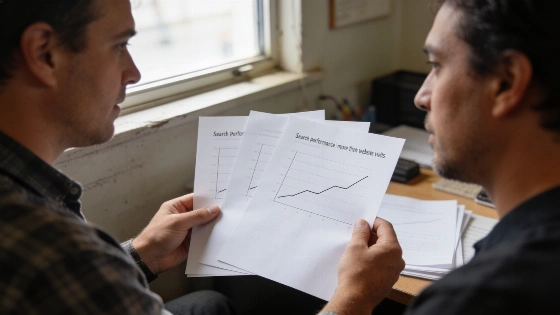
A search result can expose a brand without sending a visitor to its website; that gap makes traffic and rank reports incomplete measures of SEO performance, ResultFirst says. The performance SEO agency recommends measuring search visibility alongside engagement and business results, especially for organizations using enterprise SEO services.
The numbers describe different parts of the search journey. BrightEdge research found organic search drives more than half of all trackable website traffic. A 2026 analysis by SparkToro and Datos estimated that 68.01% of U.S. Google searches ended without a click to the open web, compared with 60.45% in 2024 under the same methodology. The analysis covered January through April 2026 and drew on a U.S. desktop and mobile web clickstream panel, with mobile weighted at roughly two-thirds; Google’s app was excluded. One figure measures traffic sources; the other measures searches that do not produce an open-web click.
Google has reported that AI Overviews reach more than 2 billion users each month; a 2026 figure attributed to Alphabet put monthly reach above 2.5 billion. AI Mode is a separate product, reported to have more than 1 billion monthly users. Monthly reach measures exposure to a feature, not clicks on cited pages or transactions. A Pew Research Center study tracked 900 U.S. adults across 68,879 Google searches in March 2025. AI summaries appeared in about 18% of the searches observed. Users clicked a traditional result in 8% of visits when a summary appeared, compared with 15% when it did not; 1% clicked a link within the summary. The study measured browsing and clicks, not brand recall, conversions or the commercial value of citations.
A 2026 working paper by Saharsh Agarwal and Ananya Sen reported a randomized field experiment involving 1,065 U.S. desktop Chrome users and 68,089 searches conducted from January 7 through February 10. Hiding AI Overviews raised outbound organic clicks per search from 0.37 to 0.62. The reported probability of a zero-click search was 0.73 when an AI Overview appeared and 0.54 when it did not. The findings were reported as a working paper.
That makes visibility harder to read from rankings alone. Featured snippets, local listings and AI summaries can show a brand without generating a site visit. Mentions and citations in AI answers may offer another signal, but measurement standards are still developing. Businesses can track whether their content is cited and whether references are accurate. Impressions do not establish that users remember a brand, while branded searches can also reflect other marketing.
Rank tracking has its own measurement caveats. A rank-tracking report described suspected poisoned search results affecting monitoring tools, a separate issue from searches that end without a click.
Technical foundations still matter. Google primarily uses a site's mobile version for indexing and ranking. Its mobile-first indexing guidance says Google must be able to access and process mobile content. Important content and robots directives should be consistent across mobile and desktop versions, as should structured data. Google does not require a mobile version for a page to appear in Search. Core Web Vitals cover loading performance through Largest Contentful Paint (LCP). Interaction to Next Paint (INP) measures responsiveness, while Cumulative Layout Shift (CLS) measures visual stability.
Structured data helps search engines interpret products and organizations. It can also describe articles and make eligible pages suitable for enhanced search features; it does not guarantee rankings or AI citations. ResultFirst recommends monitoring indexation and mobile usability alongside structured data and page experience.
Traffic alone leaves the commercial picture unfinished. Qualified leads and conversions show whether organic visitors take useful actions; customer acquisition and revenue help connect those actions to business results. Attribution complicates that accounting: a person might discover a company through organic search, return directly, then buy after an email. Assigning the entire sale to one channel can miss that sequence.
Google Search chief Liz Reid said on August 6, 2025, that total organic click volume from Search to websites was roughly stable year over year and that quality clicks had increased slightly. Traffic studies can measure different populations, periods and outcomes: Pew examined click behavior on searches with and without AI summaries, while Google's statement addressed aggregate organic click volume.
Privacy rules add constraints to the data businesses can collect and process. GDPR and the California Consumer Privacy Act (CCPA), as amended by the California Privacy Rights Act (CPRA), affect tracking and analytics, consent management, and customer data collection. ResultFirst offers search optimization, AI SEO content strategy and analytics services.








