

AI platforms like ChatGPT and Gemini often miss or misrepresent local businesses. Learn how to benchmark your business’s presence, accuracy, and trust signals in AI-driven search before investing in local SEO.
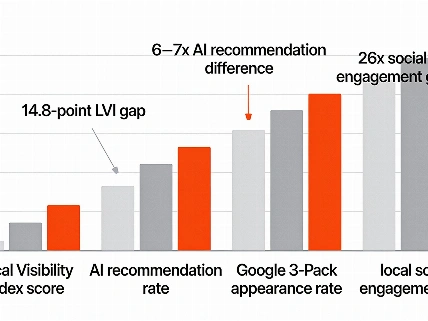
Most local business owners still rely on their Google Business Profile to gauge online visibility, but that approach misses a critical shift: AI search platforms now play a major role in customer discovery. According to SOCi’s 2026 Local Visibility Index, ChatGPT recommended just 1.2% of nearly 350,000 business locations analyzed, while Google’s local 3-pack featured those same brands 35.9% of the time. Gemini surfaced 11% of locations, and Perplexity 7.4%. These gaps highlight how AI-driven search can overlook even well-optimized businesses.
Accuracy is another challenge. Business profile data was only about 68% correct on ChatGPT and Perplexity, compared to 100% on Gemini, which pulls exclusively from Google Maps. This means a business can dominate traditional map results but remain invisible or misrepresented when customers ask AI for recommendations.
To address this, a local GEO baseline audit offers a systematic way to measure how AI platforms describe, recommend, or ignore your business. This process helps you identify issues before investing further in local SEO efforts.
Why start with a baseline? Establishing a baseline is like weighing yourself before starting a fitness plan. Without initial numbers, you can’t track progress. A baseline audit provides metrics such as share of voice, citation rate, and data accuracy. It also reveals whether AI can crawl, interpret, and trust your site-crucial information before developing content strategies.
AI search weighs signals differently than traditional local search. While proximity is key for map packs, AI prioritizes data confidence, authority, and consistency across the web. Third-party validation and accurate business information matter more than location. As a result, strong map-pack rankings don’t guarantee AI visibility.
Step 1: Gather your audit inputs
Start by organizing a spreadsheet to cover four types of queries: Discovery (“best [service] near me”), Comparison (“[Brand] vs. [Competitor] in [city]”), Trust (“[Brand] reviews”), and Logistics (hours, address, parking, phone). Run each query on ChatGPT, Perplexity, Gemini, and Google AI Overviews. Each platform uses different data sources and may produce different results.
Control for variables that can skew results. AI responses change based on user location, so always test from a defined city or ZIP code. Run both logged-in and logged-out sessions to minimize personalization. Date-stamp every test, as AI models update frequently.
For a deeper look at how AI search is evolving, see how advertisers are adapting to new tools and markets in this recent coverage of OpenAI’s ChatGPT Ads expansion.
Step 2: Run prompts and log results
For every prompt on every platform, record whether your business is mentioned, its position in the answer, the sentiment (positive, neutral, negative), factual accuracy (hours, services, prices), and which sources were cited. Set up your spreadsheet with columns for prompt, platform, mention, position, accuracy score, sentiment, citation count, and top sources. Calculate visibility and accuracy percentages to summarize your findings.
Track competitors as well. Note which businesses appear, their ranking, and supporting sources. This reveals who leads your category in AI search and why.
Step 3: Diagnose the gaps
Gaps typically fall into three categories: Invisible (your business doesn’t appear for relevant queries, often due to blocked crawlers or lack of citations), Inaccurate (your business appears but with outdated or incorrect details, usually from inconsistent NAP data), and Misframed (your business is mentioned but ranked low or described unfavorably, often due to weak reviews or authority signals). Identifying the type of gap helps prioritize fixes.
Step 4: Fix issues in the right order
Address eligibility first: ensure AI crawlers can access your site by checking robots.txt and Cloudflare settings, standardize NAP data, and implement structured data like LocalBusiness and FAQ schema. Next, strengthen trust signals by building a robust review profile, responding to reviews, and maintaining consistent messaging across all platforms. Only after these steps should you focus on content, adding location-specific details and real examples to your pages.
Optimizing relevance before eligibility is ineffective-if AI can’t access your site or your data is inconsistent, new content won’t help.
Step 5: Make the audit repeatable
One audit provides a snapshot, but repeating it quarterly helps track progress as AI models evolve. Monitor mention rate, positioning, factual error rate, and citation count over time. If your business’s mention rate improves but it remains buried below competitors, focus on trust-building. Compare each audit to the last to spot model drift or shifts in AI preferences. Keep an eye on competitor share of voice to avoid falling behind.
Ultimately, a local GEO baseline audit lets you benchmark your business’s AI search presence, address eligibility and trust issues before investing in content, and adapt as AI platforms change. Skipping this step means risking missed calls and lost customers to competitors-often without realizing why.