A major media group lost nearly all its organic traffic after a domain migration. Fixing soft 404 errors and indexing issues restored visibility across 13 country sites. The recovery offers key lessons for publishers facing similar SEO challenges.
When a large media publisher migrated its Brazilian cryptocurrency news site to a new domain, the result was a dramatic 90% drop in organic traffic. For digital publishers, this case highlights how technical SEO missteps can erase years of audience growth-and how systematic fixes can reverse even severe declines.
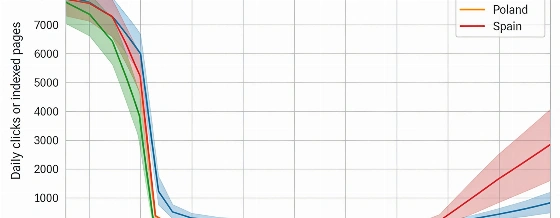
After the January 2022 migration from xx.com.br to br.xx.com, daily clicks fell from 15,000-25,000 to just 2,000-4,000, according to Google Search Console data. This collapse persisted for over a year, with no sign of recovery, even as the site weathered three major Google algorithm updates in June 2021. The expected post-migration rebound never arrived.
Investigation revealed that Google continued crawling the old domain long after the switch, splitting crawl budget and preventing authority consolidation. Redirects and technical protocols were incomplete, leaving Google confused about which domain to prioritize. Only after the SEO and IT teams addressed these migration gaps did the first signs of recovery appear, with a modest uptick in clicks and impressions by late August 2022.
However, the migration fix exposed a deeper problem: a massive indexing backlog affecting all 13 country-specific domains. While Google crawled new articles within two minutes, it took up to 24 hours to index them-an unacceptable delay for a news publisher covering fast-moving cryptocurrency topics.
In January 2023, Google Search Console showed 513,369 pages in Brazil alone as "Crawled - currently not indexed," along with 1,193 soft 404 errors and thousands of alternate or discovered-but-not-indexed pages. The culprit: auto-generated converter pages with thin content, which consumed crawl budget and led Google to deprioritize the site.
Soft 404 errors-pages returning a 200 status code but lacking meaningful content-emerged as the most damaging issue. Unlike hard 404s, these errors quietly accumulated, confusing search engines and wasting crawl resources. The problem was widespread: xx.com had 90,400 soft 404s, es.xx.com (Spain) 17,700, kr.xx.com (Korea) 15,400, fr.xx.com (France) 15,100, and de.xx.com (Germany) 8,010. In France, as soft 404s grew in late 2022, daily crawl requests dropped by more than half.
This crawl budget crisis meant Google spent resources on low-value pages, slowing the indexing of new content and reducing search visibility. For a publisher releasing dozens of articles daily, this created a feedback loop: delayed indexing led to lower engagement, which further reduced crawl allocation.
Starting January 31, 2023, the publisher launched a technical SEO remediation plan. The team prioritized resolving soft 404s by ensuring empty pages returned proper 404 or 410 codes and fixing content where possible. They removed or noindexed auto-generated converter pages, tightened URL parameter handling, blocked low-value patterns in robots.txt, and improved canonicalization. Core Web Vitals were addressed as a secondary priority, with the team focusing first on restoring indexing health.
The results were rapid and measurable. In Brazil, "Crawled - currently not indexed" pages dropped from 513,000 to 220,000, and soft 404s fell by 69%. Germany saw indexed pages rise from 150,000 to 370,748, with daily clicks increasing to 12,000-15,000. Poland’s indexed pages grew to 135,556, with traffic spikes above 30,000 clicks per day. Spain’s Google Discover clicks more than doubled, with Discover now accounting for 65% of total traffic. Across all domains, soft 404s dropped from 120,000 to under 20,000 by late April 2023.
Improvements to Core Web Vitals were mixed. Desktop performance rose sharply in Germany, Poland, and Korea, but mobile scores stagnated or regressed in Brazil, Argentina, Thailand, and Turkey. The team attributed this to regional infrastructure differences, noting that not all technical fixes yield equal results across markets.
Key lessons emerged: indexing issues must be addressed before content or speed optimizations; soft 404s can silently erode traffic; migrations require exhaustive validation; crawl budget matters for high-volume publishers; and regional differences demand tailored solutions. Google Discover’s role as a traffic driver also grew, but only for sites with strong technical health.
For publishers planning migrations, the team recommended a 12-week phased approach: audit and prioritize issues, fix soft 404s, address crawled-but-not-indexed pages, and monitor recovery. In this case, pre-migration forecasts suggested the Brazilian site should have reached 20,000+ daily clicks, but indexing issues suppressed 65-75% of potential traffic. Across all domains, nearly 500,000 pages went unindexed, costing millions of monthly impressions.
Technical SEO debt compounds over time. What starts as a few hundred soft 404s can quietly grow into a crisis, with Google gradually deprioritizing affected domains. The publisher’s experience shows that systematic remediation can restore lost traffic, but only if issues are identified and addressed at scale. For more on how newsrooms are rethinking traffic metrics and success, see this analysis of how Financial Express Digital is shifting its editorial focus.