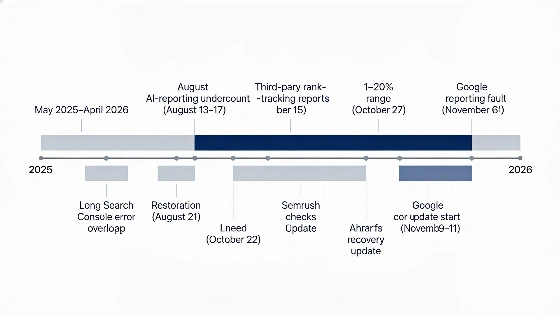
Publishers trying to distinguish changes in AI search visibility from ranking shifts faced overlapping measurement problems in November. Google’s Generative AI performance report undercounted appearances from 9 to 11 November 2026. The error overlapped with the 10 November start of a global search ranking update. Google described the incident as a logging error affecting report data, not websites’ actual performance in Search, as Search Engine Land reported.
The report tracks appearances in AI Overviews and AI Mode, a separate measurement layer in Search Console for Google’s AI search features. Google said, “This issue affects data logging only.” The statement describes a reporting fault; it does not quantify how many impressions were missed.
Google has not said whether it will restore the missing figures. Its November 2026 core update began on 10 November at about 10:06 a.m. Pacific Time. Google said the global, all-language rollout could take up to two weeks; it was the third Search core update of the year. Google recommends waiting until a core update is complete and then allowing at least one full week before analyzing Search Console performance, as Search Engine Journal reported. The first two days of the rollout overlapped with the AI impression logging fault. That made it harder for businesses and publishers to tell whether their visibility in Google’s AI features changed during that period.
The uncertainty extends beyond Google’s own reporting. Ahrefs and Semrush have separately reported that some automated searches returned results unlike those a typical Google user would see. A related report covered Semrush’s account of suspect results affecting rank trackers.
Reports of third-party tracking problems date to at least 15 September. On 22 October, Ahrefs estimated that between 5 and 20 per cent of results collected by SEO data providers were affected, depending on the provider. The company did not publish a sample size or methodology, so the estimate does not establish how often the issue affected all tracked searches.
Ahrefs said on 6 November that its first-page data had largely recovered. Additional checks were delaying some updates for results further down, and the company said it was reviewing historical data. Semrush said on 27 October that it had added checks to flag suspect results and rerun those searches.
One Semrush example involved an automated search in Brazil for a specific baby stroller. It returned a dental supplier’s equipment page. Google has yet to publicly explain why some automated requests produced different results.
Bad rankings can also distort traffic estimates. Ahrefs uses ranking positions to estimate how many clicks a website might receive from Google, so an incorrect position can carry through to the traffic figure in the same report. Ahrefs has not publicly broken down which historical reports were affected.
Google’s anomaly log records earlier reporting problems, too. A similar AI search undercount ran from 13 to 17 August, and Google restored the missing figures on 21 August. A separate error affected impressions from May 2025 to April 2026. Average position and click-through rates were also affected; Google said click counts were not.