
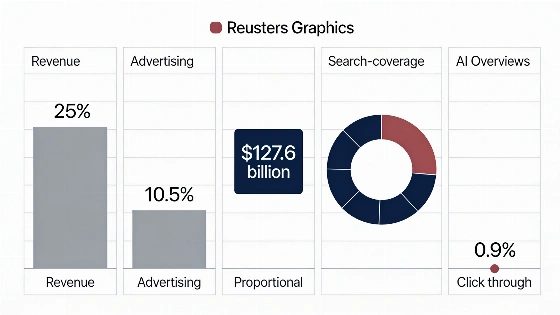
AI Overviews appeared on more than 80% of Google searches in October, according to the monthly roundup. They also began appearing for searches with typos and queries that returned no results. Google changed how links appear in AI Overviews and AI Mode, but said it would not show click data for those links. A small opt-out study put the click-through rate for AI Overviews and AI Mode at 0.9%; the roundup gives no details about the study’s sample or methods. Google separately reported on October 28 that its AI investments were increasing Search usage and overall query growth, including commercial searches. Alphabet CEO Sundar Pichai said AI Mode queries were three times longer on average than traditional searches. He added that one in five AI Mode searches globally used voice, images or documents. Google also said it had surpassed 50 billion visual searches per month and described AI Overviews, AI Mode and traditional Search as one smooth experience, according to its Q3 2026 earnings remarks.
Those changes came as Google completed its September 2026 spam update and search-ranking volatility drew attention throughout October. Barry Schwartz’s November report also tracks unconfirmed ranking swings as the industry waits for another core update. The roundup lists volatility spikes on October 20 and 21, as well as October 24. It says the September update’s second phase arrived on September 30. Google released the spam update on September 24, and its Search Status Dashboard marked it complete on October 8. Google Search advocate John Mueller cautioned that it could take longer than some recent updates to settle.
AI in search
Google introduced link changes across AI Overviews and AI Mode, and some of AI Mode is powered by Argon 4. The roundup also notes tests and launches involving Nano Banana 2.1 and Universal Cart in Google Search in the U.S. Other reported changes include the removal of AI Overview labels on some results and a test that may drop citation cards. The wording matters: a test does not establish a general rollout. In October, Google also raised links within AI responses and added image thumbnails to related links. It expanded news carousels and tested a top section featuring official websites. Lumar reported these changes as part of an effort to direct more visitors from AI results to the wider web. It also noted that some features were tests and that news carousels were expanding to more locations and languages.
A separate small study found a 0.9% click-through rate for Google’s AI search features. That figure comes from a study, not from Google, and the available material does not establish how broadly it applies. Reporting on Cyrus Shepard’s opt-out case study said AI impressions accounted for about 8% of the tested site’s total impressions, then fell to zero after the site was excluded from AI Overviews and AI Mode. The study also recorded a decline in ordinary organic clicks during the opt-out period. Publishers tracking the changing presentation can compare it with earlier browsing data, which examined traditional-link clicks on visits with AI summaries.
The roundup also describes three new studies that questioned the value of investing in AI visibility and search, but offers no methods or results to assess. Google added controls related to AI training and expanded details on top-level domains in its Search Generative AI control page. Separately, Google and Microsoft reportedly supported a robots.txt rule that would let publishers opt out of AI training. That control concerns the use of web content for training; the Shepard experiment involved excluding a site from AI Overviews and AI Mode.
Search guidance
Google revised its documentation on AI-generated content, advising people to fact-check and review it for accuracy. Its helpful content guidance now includes sections on main content and EOT/SA, and Google warned against deceptive authorship information. The company also updated guidance on tools and user-generated-content spam. These are changes to documentation and guidance. The roundup does not say that every site using AI content or user submissions faces a penalty.
Google shared information about timelines for crawling, indexing and serving, updated its crawl-rate documentation with Retry-After HTTP guidance, and revised URL best practices for hyphens. Other documentation updates covered robots.txt rules for AI crawlers and indexing API quotas, along with favicon redirects and emergency PHP exploit remediation. Google also explained why 404 errors are not inherently alarming and said Search Console does not show every spammy link. A multi-select country filter arrived in the Search Console Performance report.
The report raises possible increases in manual actions as a question, rather than confirming a broad penalty wave. It also recounts Google comments on bot impersonation and AI spam, along with fresh index reporting and large product aggregators. Google’s John Mueller said systems would eventually catch AI spam and tricks. Gary Illyes said AI had made bot impersonation worse.
Business and local
Google reported 25% revenue growth to $127.6 billion, while missing Wall Street profit expectations amid heavy AI infrastructure spending and slower growth in core search advertising. Ad revenue was up 10.5%. Google also said ads in AI Mode were earning less than traditional search ads. The report says the AI Overview lawsuit was dismissed over the lack of an agreement with publishers. By late October, Google was also testing a mix of sponsored and organic products in AI Mode, query-refinement controls at the top of AI Overviews that opened AI Mode, and the removal of citation panels from some AI Overviews.
For local businesses, Google is rolling out a new Business Home and advanced performance reports. Business Profiles added third-party ordering controls and expanded AI-powered messaging. Review appeals were delayed again. The roundup also notes Facebook Messenger links and a WhatsApp button in the local panel, along with requests for EINs and government-ID verification.
Elsewhere, Google Search Profiles expanded to India and Canada, with Brazil described as coming soon. Google shared subscriber data for preferred sources, and Discover was characterized as moving toward a hyper-personalized concierge experience. The report also covers a possible return of the 100-results parameter and a platform for building connected apps for Google Search. Forum discussion took place at WebmasterWorld.








