A review of 3,000 listicles shows that recent publication dates and clear item counts are the main factors for ranking high in Google and AI-powered search. Publishers still lead, but the landscape is changing quickly.
Listicles with recent publication dates and clear item counts are dominating Google’s top search results, while older or vague roundups are losing ground. In a review of 3,000 high-ranking listicles, the pattern is clear: up-to-date content and specificity matter most, and the numbers back it up.
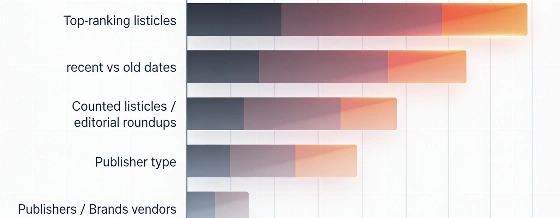
Pages published within the last two years appeared in 66.6% of top-three search results, compared to 57.3% for those in positions eight to ten. If Google’s crawler can’t find a recent or readable date, the chance of a top-three ranking drops by 56%. Search engines and large language models favor new content, and the effect is obvious. A study by Index Lab and Search Engine Land found that the freshness of a listicle’s publication date was the strongest ranking signal, with recent dates making top positions much more likely. [Source]
"In a dataset of 60,000 queries and over 5 million results, listicles with explicit item counts in their titles outperformed editorial roundups in 56.8% of direct comparisons."
- Index Lab
But it’s not only about when the page was published. Listicles that include the number of items in the title-like "17 Best Project Management Tools"-consistently beat those with generic titles. In 6,114 direct comparisons, counted listicles ranked higher 56.8% of the time. Their average best rank was 3.77, compared to 4.59 for roundups. The effect is stronger with bigger numbers: listicles with 51 to 100 items averaged a 4.11 rank, while those with just 2 to 5 items dropped to 5.85. These results come from the same Index Lab analysis, which also found that larger numbers in titles usually meant better rankings. [Full study]
Signals that matter
Publishers have the edge over brands. In the latest analysis, publishers produced 46.8% of the highest-ranking listicles, while brands and vendors accounted for just 19.2%. In direct comparisons on the same search page, publishers won 54% of the time. The topic matters, too: beauty and fashion queries had listicles in the top ten 67.2% of the time, while entertainment and gaming were lower at 42%.
The competition is getting tougher. Reddit and YouTube now show up in 92% of search results with lots of listicles, and AI Overviews appear in 83.7% of queries-rising to 93.4% in B2B software. The fight for attention isn’t just about organic rankings anymore; it’s about standing out in search results crowded with user-generated content and AI summaries. However, the 92% figure for Reddit and YouTube is not directly confirmed by primary research and should be treated with caution, as noted by Search Engine Land and Index Lab.
"Google has confirmed that AI Overviews now reach over 2.5 billion monthly users, and new AI-related reports have appeared in Search Console-though without click or CTR data. This expansion increases visibility in AI layers of search, but makes it harder to measure the true impact on organic traffic."
- SearchPrex
Word count and image volume help a bit: top-three listicles had 21.5% more words and 38.9% more images at the median. But adding too many section headings actually hurt rankings, with a 29% drop in top-three odds after adjusting for outliers. Big numbers in titles suggest depth, but overloading a page with headings doesn’t pay off.
Self-promotion and the listicle dilemma
Self-promoting listicles-where vendors put their own products first-haven’t disappeared. In fact, those published late last year saw traffic jump 3.5 times higher than their peers. Among 83 manually reviewed B2B pages, median organic traffic reached 1,977 in August 2026, compared to 568 for 600 control listicles. 74.7% of eligible B2B vendor comparisons put the publisher’s own product at the top, and 90.4% of these self-promoting pages gained traffic year-over-year.
But the growth isn’t just from self-promotion. After adjusting for starting traffic, industry, and other factors, the advantage drops to a small and statistically insignificant 4%. The real boost seems to come from more effort and investment in listicle content, not just putting your own brand first. As AI-powered search and reader skepticism grow, simply calling yourself "Best Overall" is no longer enough.
For creators debating whether to rank their own products first, the advice is simple: back up your claims with third-party data, or let an affiliate or independent reviewer handle the comparison. Otherwise, expect readers to go straight to Reddit for unfiltered opinions-a trend covered in this report.
AI Overviews and the future of listicles
Google’s changing approach is reshaping the value of listicles. Where the search engine once avoided direct recommendations by surfacing curated lists, AI Overviews now give brand suggestions directly. This shift, driven by personalization and longer prompts, means Google is more willing to name names-raising the stakes for anyone relying on listicles for traffic. Recent independent reports from late August and early September 2026 confirm that Google is testing broader AI Overviews in search, sometimes showing them automatically, which increases "zero-click" pressure on organic results. [9to5Google]
The findings are based on a large dataset: 59,984 Google search results pages, 60,000 US English queries, and 15 verticals. The analysis compared counted listicles and editorial roundups, crawled 3,000 ranking pages for objective signals, and tracked organic traffic changes from January 15 to August 24, 2026. Vendor-owned listicles were checked for self-promotion, with only those comparing real peer alternatives included.
Listicles aren’t disappearing, but the rules are changing. Freshness, clear item counts, and publisher authority are now essential. Over-structuring and obvious self-promotion are more likely to hurt than help. As Google’s AI Overviews play a bigger role in brand recommendations, the window for gaming the listicle format is closing. The winners will be those who adapt quickly, using data-backed claims and real editorial value, while others risk being lost among AI-generated answers and user-driven content.
Google, founded in 1998, is still the world’s leading search engine, handling over 8.5 billion searches per day as of 2026. Its ongoing algorithm updates and the rollout of AI Overviews have forced publishers and brands to keep changing their content strategies. With a US search market share above 85%, Google’s ranking signals and content preferences remain crucial for digital visibility and revenue.