9 Tests Authenticated MCP Access for Enterprise Publishers
Five Nine mastheads are included in an Australian test for enterprise subscribers. The pilot adds an authenticated MCP layer to existing APIs ahead of a broader commercial rollout.
Dispatch is printing 2,000 copies of a broadsheet priced at £6.50 each. The edition has no fixed publication schedule and will sit alongside the UK publisher’s digital reporting.
KG Media says licensing its content to AI companies contributes 4% to revenue, compared with about 1% from internal AI tools. Kleine Zeitung is charging some bots for access and has blocked Amazon’s crawler.
Coeditor will become available to Pugpig customers through a significant multiyear investment from Old Queen Street Media. The companies also plan a commenting platform with AI-powered moderation.
People Inc says non-session revenue grew 15% as core website sessions fell 26%. It is expanding through licensing, with events and apps also in the mix, while overall revenue declined.
A Known Agents review found about 2% of 1,000 leading English-language publisher sites disallow all bots by default. In a separate index, bots generated 34% of pageviews across 5,000 websites.
The digital launch was followed by more than 70,000 subscribers and 11 months of reported average monthly revenue growth of 30%. Riley gave no pound figures, and the print comparison excludes newsstand sales.
Hint reports 40,000 newsletter subscribers and a 70% open rate, with women making up 85% of its audience. Its Stockholm-focused 08 newsletter had 2,500 signups two months after launch.
A machine-learning score helps a publisher target retention offers at subscribers most likely to leave. The flagged group churns at about seven times the overall rate.
In the first four months of 2026, 68% of U.S. Google searches ended without a click. Schantin argues that publishers’ value depends on editorial choices a named person can answer for.
The Times says comments help subscribers feel part of a community. A four-person team moderates the discussions while writers and readers bring new reporting into the conversation.
More than 1,500 people signed up for Second Chapter’s newsletter before launch. The publication plans to add paid tiers in February 2027 while building revenue around memberships and sponsored events.
Proper Cardiff News serves free and paid readers, with most in-depth reporting behind a paywall. Its founders say the Cardiff title could become a model for expansion across Wales.
Paul Bascobert said he cannot account for every agent staff create. The risk extends beyond security: Reuters also wants AI systems to become customers for its journalism.
Actu says its move from free ad-supported news to a mixed model has brought 8,000 net active subscribers. Digital revenue now accounts for 35% of the group’s total.
A new digital magazine helped Attitude more than double its Apple News revenue in a year. The publisher also reports stronger reader activity, with issue opens up 371%.
More than 280,000 individual subscribers account for 99% of Mediapart’s annual revenue. The French investigative outlet has been profitable for 15 years and has no loans.
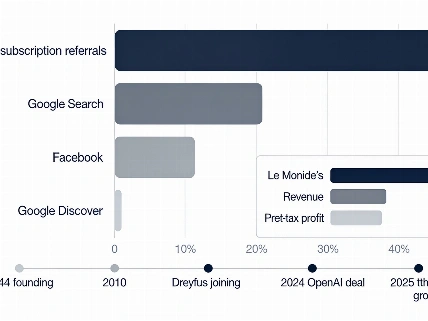
Dreyfus says changes to online discovery algorithms are the main factor in falling publisher audiences. Le Monde says ChatGPT referrals bring 13 times as many subscriptions as Google Search.
The sharpest risk in five forecasts for 2027-28 may have little to do with technology: publishers cannot assume younger people will become habitual news readers.
Weekly use of standalone AI tools rose to 51% across six countries tracked by the Reuters Institute. Yet only 12% of respondents are comfortable with news produced entirely by AI, while Axel Springer’s U.S. margins have fallen to 2%.
The Times added 420,000 digital subscribers in the third quarter and reported 13.76 million total subscriptions. Print subscriptions fell year over year while affiliate and licensing revenue rose.
Versant expects $6.2 billion to $6.45 billion in revenue as profitable linear TV declines. Platforms revenue rose 10% to $245 million, while the company reported $302 million in cash flow.
A Hungarian publisher says Gemini used its articles without permission. The EU court adviser says unlawful access or answers that replace originals could breach publishers’ rights, while training claims lack evidence in this case.
The CJEU has yet to rule. Its adviser says Gemini’s use of publishers’ articles may infringe their rights in some cases, while AI training on text remains permitted under an EU exception.
Ringier’s preliminary Blick analysis puts logged-in users’ lifetime value at seven times that of non-logged-in users. Loyalty matters too: brand lovers can generate up to 26 times the ARPU of casual readers.
The New York Times alleges Brave supplied publisher content to AI developers and helped users get around paywalls. The cases were filed in Manhattan federal court.
The complaints target Brave’s paid access to its search index and browser features publishers say let readers get around subscriptions. The cases could test how far browser liability extends.
The News/Media Alliance says ChatGPT sends publishers 96% less referral traffic than traditional Google search, citing research in its court brief. The filing challenges OpenAI and Microsoft’s fair-use arguments.
The Times says its new recipe tool can adjust ingredients such as chard and spinach. In a scan of 171 comments, roughly 77% of reader responses were negative, while some praised dietary substitutions.
Vox’s new app puts its journalism in one mobile feed, with text access and ad-free podcasts reserved for paying members. The launch comes as Comscore data shows a 36% year-over-year decline in site visitors.