
Should brands concentrate their content on a handful of core topics, or is it better to cover as many subjects as possible to maximize reach? New research analyzing Semrush’s AI Visibility Toolkit data suggests that depth, not just breadth, is what makes brands stand out in AI-powered search results.
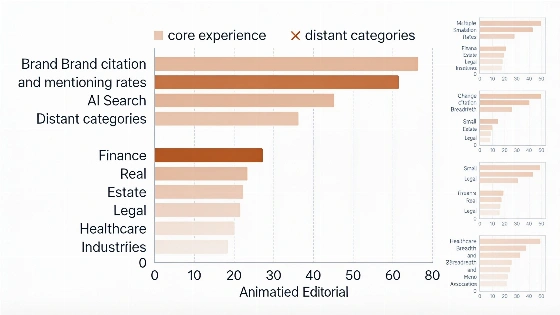
The study examined over 1,000 categories and tracked how often brands were cited or mentioned by AI systems like ChatGPT. It found that while brands can be cited as sources in topics far from their main expertise, they are only recommended-named directly-when they have established repeat authority in closely related categories. In distant topics, 50% of brand appearances were citations, but just 25% were direct mentions, and only 9% achieved both. In contrast, in categories aligned with a brand’s core expertise, 74% were cited, 44% were named, and 34% received both forms of recognition.
These findings highlight a key distinction: AI search engines are willing to cite brands broadly, but reserve recommendations for those with a proven track record in a specific area. Citation-only presence remains steady regardless of topic relevance, but named mentions cluster around a brand’s core strengths.
To test whether authority in one category helps brands expand into others, the research ran three tests: a relatedness test (comparing new category appearances to established ones), a future performance test (tracking mentions and citations over six months), and a breadth vs. depth test (measuring the impact of covering many topics versus focusing deeply on a few). The results showed that being cited in many categories does not penalize a brand, but shallow presence-appearing in only one out of five prompt variants-leads to fewer mentions. Brands that consistently appear across all prompt variants in a category are more likely to gain recognition when expanding into new areas.
However, the effect of topical authority is not uniform across industries. Finance and real estate showed the strongest gains from repeated citations, with citation-breadth associations rising from +0.054 to +0.139 in finance and from +0.021 to +0.135 in real estate as coverage deepened. In these sectors, expanding into related categories can be an effective strategy, as broader coverage leads to higher source visibility. Legal and healthcare, on the other hand, impose stricter requirements for brand mentions. Even with full coverage, legal saw a negative mention-breadth association of -0.058, and healthcare -0.037, suggesting that being a credible source is not enough to earn recommendations in high-stakes fields.
For teams in finance and real estate, tracking citations can serve as an early indicator of successful category expansion. In legal and healthcare, repeat mentions-not just citations-are necessary to truly win a category. The research also notes that other factors, such as writing style, overall brand authority, and third-party web mentions, may outweigh topical authority in determining AI visibility.
For those looking to measure their brand’s AI presence more directly, strategies like those discussed in this guide to tracking brand visibility in Gemini can help connect AI mentions to real business outcomes.
The study’s methodology relied on Semrush’s U.S. ChatGPT dataset from January to June 2026, covering 1,094 categories and five prompt variants per category. It analyzed 283,215 citations and 76,493 named-brand-mention observations, with each data point paired to the following month’s outcome. The models controlled for factors like current share, depth, authority score, organic traffic, branded search demand, and category-month differences. While the research demonstrates strong associations, it does not claim causation or define a maximum number of categories a brand can serve.