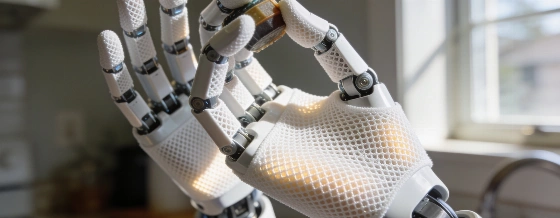
A new generation of home robots is emerging, and Neo’s advanced five-finger hands are at the center. 1X’s latest design mimics human dexterity, promising safer, more capable household automation. Early access starts at $20,000.
For decades, science fiction has promised friendly robots that handle daily chores. Now, 1X, a Norwegian-American robotics company, is moving closer to that vision with Neo, its humanoid robot equipped with five-fingered hands engineered for agility and speed. The company revealed that Neo’s hands feature 25 degrees of freedom-just shy of the 27 found in human hands-thanks to actuators that replicate the movement of human tendons.
Neo’s hands are designed to grip irregular objects, sense when items are slipping, and even hyperextend in ways human fingers cannot. Cameras and AI algorithms help the robot interpret its environment and adjust its grip accordingly. The hands are also IP68-rated for water resistance, allowing Neo to wash its own hands after tasks.
Jonathan Terfurth, director of actuators and hands at 1X, explained that the engineering team aimed to match or exceed human range of motion, enabling Neo to perform tasks like opening doors, lifting heavy items, and plugging itself in for charging. “You want to be able to operate with a human who has never worked or interfaced with a robot, and you still want it to be safe and compliant and soft,” Terfurth said. The design draws inspiration from Baymax, the gentle robot in Disney’s Big Hero 6, with a soft exterior and a 3D lattice shell.
Early access to Neo is available in limited quantities, priced at $20,000 upfront or $500 per month, with priority delivery set for 2026 for those who pay the full amount. The robot is intended to be a safe, approachable presence in the home, according to Dar Sleeper, 1X’s vice president of product and design. “Something that feels comfortable to be around, something that's soft from the inside to the outside,” Sleeper said.
Currently, Neo operates in a hybrid mode: some tasks are automated, while others require remote human teleoperation via a feature called Expert Mode. This allows human operators to control Neo and see through its cameras for complex chores. 1X says that remote access is only possible with explicit user permission, and users can monitor or revoke access at any time. Privacy features include the ability to blur faces and sensitive information, and a blue ring light signals when an operator is connected.
Questions remain about security and the extent of Neo’s autonomous capabilities. 1X clarified that some demonstration videos show fully automated actions, while others are teleoperated to highlight hardware limits. In a recent demonstration, Neo rapidly flexed its fingers at speeds that blurred on camera, showcasing the potential for both precision and speed in real-world tasks.
Founded in 2014, 1X has focused on developing safe, human-centric robotics for everyday environments. The company has raised over $100 million in funding from investors including OpenAI and Tiger Global, and employs more than 120 people across Norway and the United States. Its Neo robot represents a significant step in the race to bring practical, adaptable humanoid robots into homes and workplaces worldwide.