A single critical post or review can now dominate your brand’s search results overnight. AI-driven search and overlooked features make brands more vulnerable than ever. Here’s what publishers and marketers need to watch to avoid a reputation crisis.
One harsh Reddit thread or a negative YouTube review can now take over your brand’s search results in a matter of hours. AI-powered features like Google AI Overviews and ChatGPT are speeding up the spread of damaging content, pushing it to the top of branded searches where it can quickly erode trust and hurt conversions-often before you even notice.
Brands that used to rely on a few positive links to shape public perception are finding that approach no longer works. The first page of Google is no longer filled with company-owned pages. Instead, third-party sites, forums, and influencer content often outrank official sources, leaving brands exposed if just one of those results turns negative or goes out of date.
Google’s AI Overviews are now available in more than 200 countries and territories and in over 40 languages, with France becoming the last major Western European market to receive the feature in July 2026.
- LinkedDit
AI search doesn’t just create new risks-it brings old ones back. Content that had faded to page two or three can suddenly reappear in AI summaries, giving negative stories a second wind. This isn’t just theory. Marketers are already seeing old complaints and years-old controversies resurface, amplified by algorithms and user engagement.
Watching the traditional blue links is no longer enough. Google’s other features-image carousels, People Also Ask, autocomplete, news panels, and Google Discover-can all surface unflattering or misleading information. Each works differently, and negative mentions can slip in through any of them, often without warning.
AI and search features
AI-driven search is now a double-edged sword for brands. It can boost visibility for trusted assets, but it also means a single negative mention on a busy forum or a viral influencer video can be pushed to the top instantly. The same goes for Google Trends and Top Stories: a sudden spike in interest, good or bad, can shift your brand’s narrative in real time.
On August 28, 2026, Google confirmed that for certain queries, AI Overviews can now expand to full screen, pushing classic blue links much lower on the page. However, Google has not disclosed which query categories are affected or the proportion of searches impacted by this change.
- Pasquale Pillitteri, Industry Analyst (source)
Brands that don’t diversify their positive results are especially at risk. Relying on duplicated owned content or a handful of friendly third-party mentions is risky. Instead, companies need coverage from trusted media, Wikipedia, and respected industry outlets. This spreads out the risk and makes it harder for a single negative result to take over.
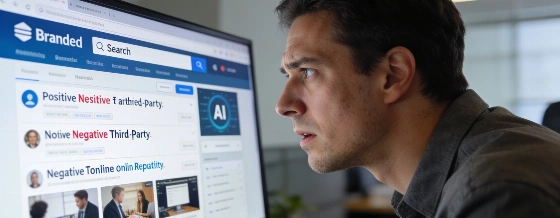
Tracking branded search results is now essential. It’s not enough to know what’s on page one today. Brands need to record, categorize, and monitor every asset-owned, third-party, positive, negative, and neutral-while watching for new themes and emerging risks. If negative results start climbing, it’s time to bring in reputation management experts before the problem grows.
Audit and action
Running a branded search risk audit is now a must. Start by identifying the exact queries your customers use, then document every result and search feature that appears. Sort each asset by sentiment and ownership, and track how these results change over time. Focus on vulnerabilities that threaten visibility, authority, or conversions, and act before competitors or critics do.
Brands that treat search results as an early warning system have a real advantage. Proactive monitoring and quick responses can stop a minor complaint from turning into a viral crisis. The real edge comes from building a search presence that’s both authoritative and diverse, making it much harder for negative content to dominate.
AI isn’t just changing how search works-it’s changing who comes out ahead. As shown in recent analysis, even advanced platforms can waste resources or miss key signals if they rely on old habits. The same goes for branded search: complacency is now the biggest risk. Brands that don’t adapt will lose ground to competitors who understand that every search feature, every AI summary, and every third-party mention is a potential battleground. The companies that succeed will be those that treat search as a living, shifting front line-one that needs constant attention, strategic variety, and a willingness to address problems before they get out of hand.
Google still leads search, handling over 8.5 billion queries per day as of 2026. Its AI-powered features, including AI Overviews and Discover, now influence more than 60% of all branded search impressions. This dominance means even small changes in Google’s algorithms or features can have immediate, large-scale effects for brands, making active search management a must for any serious publisher or marketer.