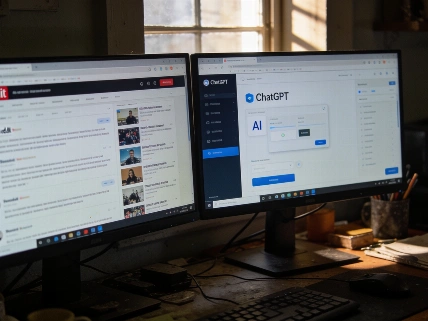

AI-driven platforms now repackage news, bypassing publisher sites. Liquid content adapts to each distribution channel. Publishers face major traffic and visibility challenges.
Media publishers are facing a sharp decline in direct traffic as AI-powered platforms increasingly repackage news content for users without sending them to original sites. According to recent data, global Google traffic has dropped by 33%, while tools like AI-Overview and AI browsers such as Perplexity Comet, OpenAI Atlas, and Dia now deliver personalized news feeds directly to users. In a Reuters Institute survey, 75% of publishers said they expect these technologies to have a significant or very significant negative impact on their business.
This shift has given rise to the term "liquid content"-content that automatically adapts its format to the distribution channel and is reassembled in real time for each user. Reuters Institute included liquid content in its 2026 forecast, highlighting feedback from 280 media leaders across 51 countries. They described liquid content as dynamic, context-aware, and responsive to user behavior, location, and time, requiring publishers to move from static articles to flexible, atomic data objects.
Atomicity is central to this approach: facts, quotes, context, and sources are stored as separate units, allowing systems to repackage them for any format. Liquid content also underpins generative optimization (GEO), which breaks down each piece of content into entities like headline, subject, fact, and date. This structure enables large language models to parse and reconstruct news more effectively. For example, the GiveMeFeed service uses GEO optimization to make news more visible to AI parsers.
Western newsrooms are not just adopting new tools-they are overhauling editorial workflows. Articles are no longer the final product but serve as structured data repositories. Traditional monolithic CMS platforms like WordPress and Drupal store content and presentation together, while headless CMS solutions separate content from display, allowing websites, apps, voice interfaces, and LLMs to access and reformat content via API. This transition, which major outlets like The New York Times began as early as 2017, laid the groundwork for liquid content by enabling structured knowledge storage.
Three recent cases illustrate liquid content in action. The Washington Post launched "Your Personal Podcast," where AI assembles a custom podcast for each listener, updating topics and hosts throughout the day. However, the launch revealed challenges with factual accuracy and invented quotes, underscoring the difficulty of maintaining precision in liquid content. Norway's VG developed VGX, a news feed where AI agents repackage stories in real time for different formats. In 2026, VG reported a 730% increase over the editorial median for subscription content, achieved by one journalist working with AI in an eight-hour shift. Finnish broadcaster Yle has also invested in liquid content, with its strategy director describing a new era where audiences "watch audio, listen to text, and read video."
For publishers, adapting to liquid content means treating content as data sets rather than fixed formats. Editorial teams are encouraged to create materials with atomic elements: headline, summary, key facts with sources, and full text. This structure supports GEO optimization, making content readable and reusable by AI systems. Implementing a headless or hybrid CMS is essential, as API-first storage is the minimum technical requirement for liquid content. Modern platforms like GiveMeFeed, Contentful, Sanity, and Storyblok can integrate with existing infrastructure.
Editorial roles are also evolving. Publishers need staff focused on data structure rather than just writing, with roles such as "knowledge editor" or "content engineer" bridging journalism and information architecture. Monitoring brand mentions in AI responses is now critical, as liquid content is often consumed without site visits. Publishers should track how often their brand appears in AI answers, the accuracy of AI-delivered content, and their presence across LLM platforms. Traffic is no longer the sole visibility metric.
Experts recommend starting small by structuring one content type-such as briefings or explainers-since these formats transition most easily to liquid content. Bauer Media CPO Marcel Zemmler has warned that publishers who fail to adapt risk their content becoming invisible, even if it still creates value elsewhere. The article as a finished product is fading, and building the right infrastructure is now urgent.