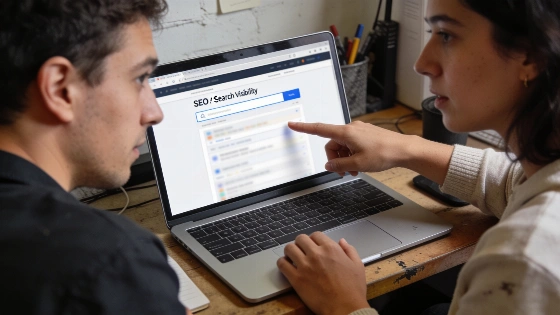
For JH SEO Agency, the practical test of AI search visibility starts with whether a retrieved passage can answer a customer without sending them elsewhere. The New York agency is expanding its answer engine improvement (AEO) and generative engine improvement (GEO) services, applying established SEO practices to how businesses appear in AI-generated answers. AEO generally focuses on direct answers, such as featured snippets and voice results, while GEO concerns a business’s mentions or citations in broader AI-generated responses.
The work starts with a basic limitation of generated responses: a recommendation may arrive without the context a customer needs to assess it. A service page might describe an offer while listing geographic coverage elsewhere. If an AI system retrieves only the first page, a customer could contact a business that does not serve their area-or miss a suitable provider whose coverage is hard to find.
What gets retrieved
That gap makes page-level clarity impressive. JH SEO Agency examines whether individual passages explain a business's services and answer likely customer questions on their own. Traditional search results give readers a route to the full website; an AI-generated answer may present a narrower account, shaped by the information the system retrieves.
The agency's GEO work also considers how a website helps search systems interpret information. Its focus includes content organization, clear headings, structured data, and credible sources. These practices can clarify a page's subject and support its claims, but they do not ensure that an AI platform will use or cite it. The research project GEO: Generative Engine Improvement, affiliated with Princeton University, Georgia Tech, and the Allen Institute for AI, tested content changes against a 10,000-query benchmark and in live generative-search environments, including Perplexity. The study examined tactics such as adding citations, statistics, and quotations, as well as simplifying language. A summary of its results reported approximately 30% to 40% relative improvement in whether content was referenced for some citation- and evidence-based changes, and roughly 15% to 30% for simpler language; these were experimental visibility measures, not guarantees of traffic or business outcomes. The GEO study describes generative engines as synthesizing answers from retrieved passages rather than simply presenting ranked links.
“A business can spend years building its reputation and still be missing from the answer a potential customer sees first. That's what makes AI search different. We're looking beyond whether a company has published the right information to whether that information can actually support the questions people are asking. Being established in your industry doesn't automatically mean you'll be part of the conversation.”
A related publisher analysis examined entity SEO and topic mastery, a neighboring concern for businesses trying to make their expertise legible to search systems.
Testing visibility
A mention in one AI answer is a weak basis for judging sustained reach. ChatGPT responses and Google AI Overviews can change with query context and the information retrieved for a query. AI systems can also break a query into multiple sub-searches, often called query fan-out, before assembling a response. A business may appear for a search about a specific service, then disappear when a customer asks which providers offer it.
JH SEO Agency says it monitors patterns across comparable searches to identify where further improvement may be useful. Brand mentions are one signal. Citations provide another, while attributable referral traffic offers a separate measure. None alone shows how consistently a business reaches prospective customers. Pew Research Center reported that, in its analysis of 900 U.S. adults and nearly 69,000 Google searches, users clicked a traditional search result in 8% of visits when an AI Overview appeared, compared with 15% when one did not. About 1% of visits included a click on a link inside the AI summary. Those figures distinguish visibility within an answer from visits to a business’s website.
The agency frames the work as an extension of SEO fundamentals, not a substitute for them. Rankings and improvement efforts cannot guarantee that a platform will include a business in a generated answer. Google Search Basic’s guidance treats AI search features as part of ongoing SEO, emphasizing crawlability, indexability, useful content, clear organization, and accurate structured data rather than a guaranteed separate ranking pathway. Its AI features guidance outlines those search fundamentals.
Services and limits
JH SEO Agency is headquartered in New York, NY. Its AI search services include AEO, GEO, ChatGPT SEO, and Google AI Overview improvement. Established capabilities include WooCommerce SEO and Squarespace SEO, along with Google Ads, Google Maps SEO, web design, and more.
Businesses do not necessarily need to rebuild a website to pursue AEO or GEO. Depending on a site's condition, existing pages may need clearer explanations, stronger supporting information, or technical adjustments. The agency says pages covering basic services may warrant attention first; priorities can also include customer questions or purchase decisions, based on business objectives, content gaps, and visibility data.
JH SEO Agency operates from New York and develops search and digital marketing strategies for businesses competing online. Its work spans organic search, paid advertising, website development, and local visibility. The agency has served e-commerce, healthcare, wellness, and service-based businesses, connecting website performance with customer search behavior and marketing priorities without relying on a single acquisition channel.
Contact: JH SEO Agency, 445 W 21st St #4F, New York, NY 10011; (213) 894-9220.