
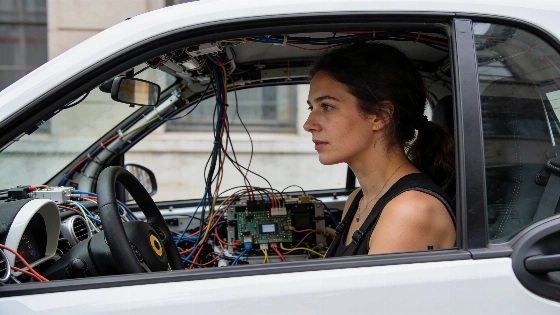
Paige Bailey, a Googler known for her work in artificial intelligence, recently shared a candid photo of herself seated in a smart car, its internal wiring fully visible. Packed with Google's latest AI-driven features, the vehicle offers a behind-the-scenes view of how emerging technologies are finding their way into automotive design.
Bailey said the car includes GoogleAIStudio Managed Agents and NanoBanana 2 Lite, along with GoogleDeepMind's Omni Flash, which enables natural-language video editing. Her post on X points to the growing overlap between AI and mobility, as software becomes increasingly intertwined with hardware. Google's automotive AI also includes Gemini, which the company describes as offering “hands-free personalized help on the road” for navigation and messaging, media, and conversational requests.
On October 20, 2026, Google announced that Personal Intelligence with Gemini had begun rolling out to Android Auto, with the feature planned for cars with Google built-in in the following months. With a user's permission, it can draw on information from services including Gmail and Google Calendar, as well as Google Search, Google Photos, Maps and YouTube, to respond to more contextual requests. Android Auto projects phone-based services onto a vehicle display, while Google built-in integrates Google services directly into compatible cars. Google presents Gemini as an in-car assistant, not a system that independently controls steering, braking or propulsion. The company outlined the rollout and its Gemini automotive plans.
This is part of a broader trend in the search and tech industry, where companies are testing new ways to bring artificial intelligence into everyday experiences. For another example of technology in an unexpected setting, a recent story captured the playful side of innovation with a look inside Google's London office elevator.
This feature appears in our daily Search Photo of the Day column, which spotlights visually compelling moments from across the search and AI field.








