SEO teams often focus on launching new pages, while older content quietly loses ground in search rankings, clicks, and revenue. Updating these existing pages can restore performance, but careless rewrites risk erasing hard-earned SEO value. A structured, 14-step workflow now enables brands to diagnose content decay, make targeted improvements, and measure the impact-without sacrificing what already works.
One transportation marketplace managing thousands of airport and route pages across multiple countries and languages illustrates this approach. Over time, every page experiences gradual decay: rankings slip, impressions plateau, and clicks decline, sometimes before analytics tools even register the change. For example, their Antalya Airport transfers page showed 148,537 impressions, an average position of 14.89, a 1.49% CTR, and 2,215 clicks over 56 days-visible, but underperforming.
Unlike new pages, updating a live, revenue-driving asset requires precision. Internal links, schema, and historical baselines must be preserved. Overhauling too much content can trigger ranking losses, as some teams have learned the hard way. Instead, the workflow tags each section as keep, fix, remove, or add, based on data-driven analysis. This ensures only necessary changes are made, protecting existing SEO equity.
Manual to Automated
The process begins with a 56-day window in Google Search Console, providing a reliable, seasonally consistent baseline. Key metrics-top queries, striking-distance opportunities, and zero-click queries-guide the update. Each section is tagged: keep if it still performs, fix if it’s outdated, remove if it’s redundant, and add if data reveals a gap.
Competitor analysis, keyword refreshes, and persona rebuilding follow. For Antalya, this revealed opportunities like “antalya airport transfer” at position 7, a gap for private transfers, and missing comparison content. Personas are built from both historical query data and synthetic queries generated by tools like SEOTesting, ensuring updates address real user needs.
Local knowledge is refreshed-terminal changes, taxi ranks, scam patterns, and review themes are checked against current sources. The page’s angle is redefined to match the needs of different traveler personas, rather than offering generic information. A delta brief outlines only what changes, and new content is written for sections tagged fix or add. For Antalya, this included an “Expert Airport Transfer Finder” component, guiding visitors to the most relevant options.
Scaling With Claude Code
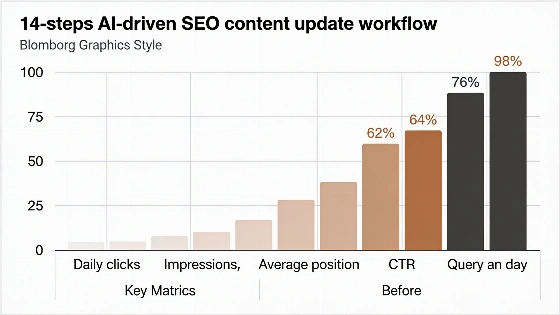
Fact-checking, image audits, and SEO preservation rules ensure accuracy and continuity. The workflow then builds any required UI components, using AI tools like Claude or Gemini to generate and iterate on modules quickly. Measurement is rigorous: SEOTesting tracks clicks, impressions, position, and CTR, while GA4 monitors commercial outcomes like purchases. For Antalya, the update delivered a 23.88% increase in daily clicks, a 3.44% rise in impressions, improved average position, and a 0.30 percentage point boost in CTR.
While this manual process takes about two days per page, scaling it across thousands of pages required automation. The team mapped each step into Claude Code skills, running the process inside a dedicated project preloaded with brand guidelines and reference materials. Claude Code automates data pulls, section tagging, competitor analysis, persona validation, brief generation, content writing, fact-checking, image auditing, and component creation. Human oversight remains essential for setting priorities and approving output, but automation enforces consistency and speed.
Deployment and Results
Deployment is now integrated: Claude connects directly to the Strapi CMS, handling staging, diffs, link checks, and schema validation. If any check fails, deployment halts for review. This continuous pipeline eliminates manual copy-paste steps and reduces errors.
Testing revealed that running multiple updates in parallel reduced quality, so the system processes one update at a time for best results. The difference is visible: updated pages feature richer local detail, dynamic components, and structured sections tailored to user intent, while untouched pages remain generic.
Across 59 completed tests, 70% of updated pages saw organic clicks increase, while 25% declined (often due to seasonality). The net result: 2,284 additional organic clicks and a 24.9% lift in organic purchases, with organic revenue up 20.1%-all measured against locked 56-day baselines. This demonstrates that systematic content updates can deliver high ROI, not just maintenance value.
What Teams Can Apply
While each brand’s priorities and personas differ, the core system transfers: humans set priorities and approve output, automation enforces judgment, and hard gates prevent generic AI output. Preservation rules protect what’s working, and every change is measured against a fixed baseline. The next evolution will monitor for early signals of decay-like softening CTR or position drift-before revenue is lost.
For teams facing a backlog of decaying pages, the key is to start with diagnostics, not rewrites. As seen in this analysis of attribution discrepancies in ad platforms, precise measurement and process discipline are essential for meaningful results. Content strategist Yvette Ramirez played a pivotal role in translating the manual playbook into a robust Claude skill chain, refining gates and tone benchmarks until automation matched human quality.
Anthropic, the company behind Claude Code, was founded in 2021 and has rapidly become a leader in AI-driven content operations. As of 2026, Anthropic employs over 400 people and has raised more than $1.5 billion in funding. Its Claude platform is now used by major publishers and brands worldwide to automate editorial workflows, with adoption accelerating as content teams seek scalable, measurable solutions for SEO and digital publishing.