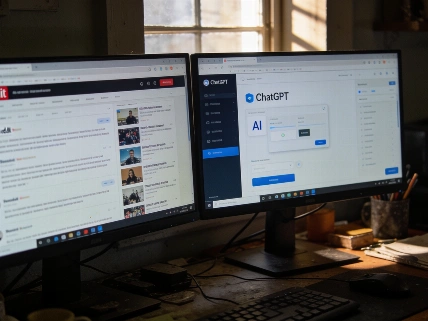

AI-driven site analysis is changing how content is discovered and ranked. Peec AI reveals the step-by-step process behind ChatGPT Deep Research’s approach. Learn what your server logs really show about its behavior.
Peec AI has published new findings on how ChatGPT Deep Research interacts with websites, offering a rare look into the AI’s browsing and content analysis process. According to the research, the system follows a structured, three-stage workflow: it starts by collecting Bing search snippets, then quickly scans the opened page, and finally performs a deeper read if needed.
Unlike traditional browsers, ChatGPT Deep Research relies on three core browser commands-search, open, and search again-without ever simulating clicks. Each page load returns only a limited text window of about 5,000 to 6,000 characters, meaning that navigation links at the top can push actual content out of view. Bing snippets themselves are short, capped at roughly 285 characters, which is about the maximum space available for initial content exposure.
The logs reveal that the most common trigger for a page to be re-read is a keyword search. In 95% of sampled cases, the agent reopens the page and jumps directly to the line containing the matched keyword. The AI also follows internal links to uncover information not present on the original page, and it reads image alt text as standard content, skipping images without descriptive tags.
Depth of search is controlled by the 'topn' parameter, which sets the number of results per query-distinct from the breadth, or number of queries issued. Notably, ChatGPT Deep Research reads far more content than it ultimately cites, so a page being read does not guarantee it will be referenced.
Server logs also show the AI’s trust assessments for each domain, and certain types of content may be blocked or rendered unreadable by the system. These insights help publishers understand how their sites are parsed and what factors might influence visibility in AI-driven search environments.
For those tracking the evolution of AI-powered search, recent updates to Google Search Console have introduced new AI-specific metrics, allowing site owners to monitor clicks and impressions tied to AI features. This shift was highlighted at a recent industry event, as discussed in this coverage of Google’s AI reporting tools launch in Milan.