
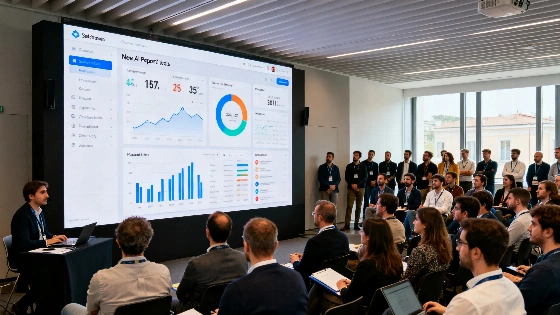
At Google Search Central Live Milan, SEO professionals got a first look at Google Search Console updates focused on artificial intelligence. International SEO specialist Stefano Fabiani shared details from the event, including the launch of a new “AI Reports (Beta)” section within Search Console.
The reporting is intended to help site owners see when links to their verified websites appear in Google’s generative AI experiences, including AI Overviews and AI Mode. Google’s generative-AI reporting provides impressions broken down by page and country, with separate views for device and date. This differs from standard Search Console performance reporting, which tracks clicks and impressions, alongside click-through rate and average position for ordinary Search data. AI-specific reporting does not provide separate click counts or query prompts, nor click-through rate or average position. Discover is reported separately from Google Search’s AI features.
Fabiani also described a dedicated AI settings panel that gives webmasters control over whether their sites are included in AI-driven features. The reporting applies to Google-controlled surfaces; it does not measure visibility or referrals from external assistants such as ChatGPT and Perplexity, or Claude and Copilot. For publishers, its value is a clearer view of appearances in Google’s AI experiences, not a complete accounting of traffic across AI platforms.
Google representatives also addressed persistent technical SEO myths. Drawing on Google documentation, they said formal HTML validation is not a ranking requirement: Google’s parsers are designed to process pages even when they contain specification errors. They also said that artificially splitting paragraphs to improve for AI is ineffective, and that content structure should prioritize readability and user experience.
These clarifications reflect broader changes in search, where technical tweaks are less likely to influence rankings than previously believed. Recent research on zero-click searches and regional differences in click behavior can be found in this analysis of click rates across major markets.








