
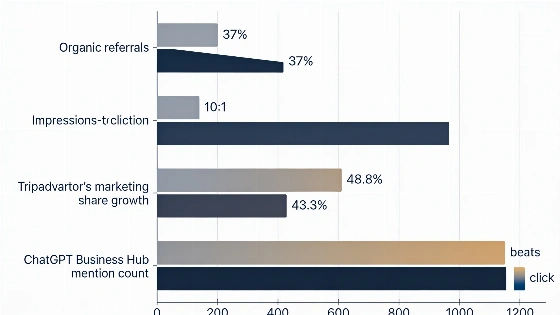
Ziff Davis recorded a roughly 37% year-over-year decline in organic Google referrals during the third quarter. On the company’s earnings call, CEO Vivek Shah said it was “not planning on a search recovery.” That forecast gives this week’s platform changes a sharper edge: visibility counts are shifting even as some publishers prepare for less traffic from search.
Traffic and revenue
Shah also said Google Search Console showed about 2.7 billion AI Overview and AI Mode impressions for Ziff Davis properties in the quarter, nearly 10 times “the clicks those same sites received from Google Search.” That is not an AI-feature click-through rate. Search Console’s dedicated “Generative AI performance report (Search)” reports impressions for links shown in AI Overviews and AI Mode, with breakdowns by page, country, device and date; it does not provide feature-specific clicks. AI Overview and AI Mode clicks remain included in the broader “Web” search type in the standard Performance report, alongside ordinary search clicks. The figures measure different populations. Search Console data on AI Mode follow-up questions may also count those questions as new queries for impressions, positions and clicks. Sites with access to the generative AI report can examine comparable visibility data, but cannot derive a feature-specific click-through rate from that report alone.
Tripadvisor is also budgeting around search pressure. CFO Mike Noonan said SEO would remain a headwind to growth in 2027. The company reported a $369.5 million non-cash goodwill impairment on its Hotels and Other segment, attributing it largely to traffic headwinds from “changes in the search landscape.” Marketing accounted for 48.8% of revenue from continuing operations, up from 43.3% a year earlier; Noonan tied the increase to a shift from free channels to paid ones.
For teams comparing visibility counts with visits, the denominator matters. That distinction is also central to earlier measurement coverage: a platform metric needs its definition beside it.
New AI search measures
OpenAI opened Business Hub in beta on Nov. 10 as part of its Businesses in ChatGPT product. Eligible businesses in places where ChatGPT is available can claim their profiles. Once they complete the claim and identity verification, Insights provides aggregated data for a recent 28-day period, provided activity meets OpenAI’s reporting thresholds. The dashboard includes mentions, website clicks and discovery topics. Businesses can also update their details and add product feeds with current pricing and availability. OpenAI says the dashboard does not expose users’ conversations or chats with Business Agents. OpenAI’s announcement describes Business Hub as a way for businesses to claim and manage their presence and view engagement insights.
OpenAI’s setup guide defines a mention for an online business as a ChatGPT reference to the business’s website. A brand name alone does not count. The guide also cautions that a blank metric does not necessarily mean there was no activity, and claiming a profile does not guarantee greater visibility in ChatGPT responses. Businesses must complete identity verification. OpenAI instructs applicants to match the business name, address and any registration or tax number to official records, as detailed in its Business Hub setup guidance.
Vahan Petrosyan, SEJ’s director of technology, submitted Search Engine Journal to the beta and reported 353,356 mentions and 2,663 website clicks from Oct. 14 to Nov. 10. Those counts are not confirmed visits: businesses need to compare the reported clicks with referrals in their own analytics. The dashboard reports aggregated referral indicators, but does not show whether a click generated a sale.
Google’s November changes
Google began its third Search core update of 2026 on Nov. 10. The Search Status Dashboard says the change “applies globally and to all languages” and “may take up to 2 weeks to complete.” At 10:06 a.m. PT that day, the rollout had just begun; the dashboard still listed it as in progress on Nov. 12. Google’s Search Central team called it “a regular update” on LinkedIn.
Google advises waiting at least a full week after a core update finishes before comparing Search Console data with the week before rollout. Based on Google’s two-week estimate, that first full week would include U.S. Thanksgiving Day. Black Friday and Cyber Monday also fall within it, complicating comparisons for retailers measuring holiday traffic against a typical week.
Separately, Google made Gemini 4 Hydrogen the default model in AI Mode on Nov. 12 and said it is using the model for some AI Overview questions. Robby Stein, Vice President of Product at Google Search, wrote on X that Hydrogen is “being used for your hardest questions in AI Overviews.” Google’s Search post says the model is available to everyone everywhere in Search and offers better query fan out, connecting users to “a broader range of helpful links than before.” Neither the post nor Stein’s thread gave a link count; the thread did not define which AI Overview questions qualify as the hardest.
For measurement, the dates matter: the model change came two days after the core update began. Logging both helps teams separate movements around each change, but cannot establish that either one caused a particular shift in citations or referrals.
Paid crawl hints
Cloudflare CEO Matthew Prince said on the company’s third-quarter call that OpenAI pays for hints telling its crawler when web pages change. The payments were one example of Cloudflare’s first revenue from Act 4, its name for products aimed at a new business model for the internet. Prince gave no dollar figure and said the call did not discuss sharing that revenue with the sites supplying the hints.
For customers seeking more visits from AI agents, Prince described Cloudflare’s assistance as “sort of the new version of SEO.” He also expects some form of micropayments, with sites potentially charging agents less when they explain why they are visiting. Cloudflare customers can allow or block individual crawlers through AI Crawl Control, available on every plan.








