
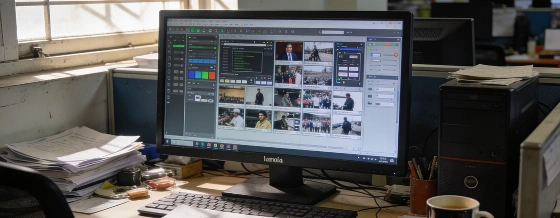
Fact-checkers at India Today use Backstory to quickly verify images. The tool automates provenance checks and context tracing. Google DeepMind is gathering feedback from journalists to improve accuracy.
Fact-checkers at India Today are using Backstory, an experimental tool from Google DeepMind, to accelerate the process of verifying images circulating on social media. The six-person team regularly faces AI-generated photos, manipulated visuals, and deepfakes, making rapid verification essential for newsroom operations. Backstory allows users to upload an image and enter a question, then automatically checks for AI generation, manipulation, and the image’s online history. The tool generates a report with citations and a log of its verification steps, consolidating tasks that previously required multiple platforms and logins.
Backstory is built on Google’s Gemini large language models and uses AI agents to determine which authentication methods to apply and in what sequence. According to Bal Krishna, who leads India Today’s fact-checking team, the tool serves as a first-pass reference, providing context and direction for further investigation. Previously, reporters had to run separate AI detection tools, reverse image searches, and manual timeline reconstructions. Now, Backstory streamlines these steps and is currently free for testers.
Currently available through Google’s Trusted Testers Program, Backstory is being trialed by thousands of journalists, OSINT experts, librarians, and researchers. Google DeepMind is collecting feedback to refine the tool, a process that contrasts with other AI authentication products often developed without direct journalist input. A July report from Princeton’s Center for Information Technology Policy noted that many commercial AI detection tools fail to address nuanced manipulations, such as images taken out of context, and often provide opaque confidence ratings that are difficult to interpret or communicate to readers.
Product manager Zoe Darmé said journalists are the core users for Backstory, though the company hopes to expand access in the future. She expects the tool will appeal most to those invested in the complexities of image verification, rather than the general public. Digital literacy expert Mike Caulfield described Backstory as filling a gap for “helpers” in the information ecosystem, including journalists and hobbyist fact-checkers. He noted that not every reporter has access to premium AI detection tools or the expertise to use a full suite of OSINT resources.
Backstory’s features include SynthID, which checks for watermarks in images created with Nano Banana, Google’s AI image generator. It also examines content credentials for encrypted metadata from companies supporting the C2PA standard, such as Google, Adobe, and the BBC. Caulfield highlighted the tool’s ability to trace an image’s online history as especially valuable, allowing journalists to see original context and track changes over time. He estimated that Backstory can reduce a process that once took nearly an hour to just a few minutes.
Google DeepMind’s own AI models, including Nano Banana, have faced criticism for contributing to the spread of disinformation and manipulated imagery. In July, Google Earth was criticized for integrating Nano Banana, which enabled users to alter 3D satellite images. Google responded by rolling back the feature and promising stronger safeguards after misleading images spread online.
Darmé said the decision to develop Backstory was driven by the need to address declining trust in online media content, rather than as a direct response to criticism of Google’s AI products. She emphasized that user feedback revealed a clear demand for an accessible provenance tool. However, like other LLM-powered tools, Backstory cannot guarantee accuracy. A disclaimer reminds users to double-check results, and conflation-where the model confuses visually similar images-remains a known issue. In one test, Backstory mistakenly identified a journalist’s headshot as belonging to another person with similar features, only correcting itself after additional input.
Backstory currently processes only images, though video support is being explored. Its context tracing is limited to images indexed by search engines, meaning content originating on closed platforms like TikTok or WhatsApp may be missed. Bal Krishna said these limitations mean India Today does not cite Backstory’s reports directly in published fact-checks; all findings are manually confirmed. Still, he described Backstory as the first robust image verification tool from a major tech company offered to fact-checkers, and expects it to improve as more feedback is incorporated. For more on the challenges newsrooms face with AI verification tools, see this analysis of gaps in current AI fact-checking solutions.