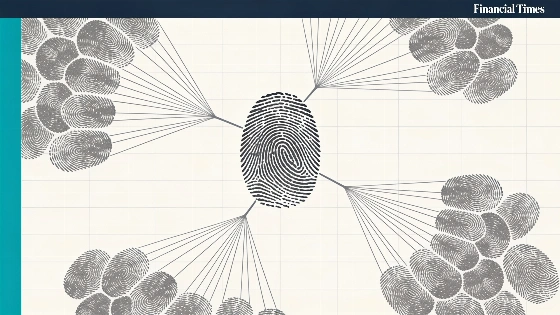
More than 6,000 fingerprint images cited in papers claiming to predict blood type matched files in the Sokoto Coventry Fingerprint Dataset (SOCOFing), which contains no blood-type information, researchers in Australia found. The finding exposes a basic problem with the studies’ reported results: the source images appear to have been sorted into blood-group categories without blood-type data.
More than a dozen journal articles and conference papers making these claims have appeared since 2023. Elsevier said it had opened an investigation into a paper published in its journal Franklin Open. IEEE said its publishing ethics team was evaluating papers published in IEEE Xplore. Retraction Watch reported those statements; the publishers did not announce findings or outcomes.
The researchers, Lars Kooijman, an adjunct engineering research fellow at Monash University, and Stephanie Summersby, an adjunct associate lecturer in the School of Psychology at the University of New South Wales, traced the images through datasets shared on Kaggle. Those collections included around 6,000 fingerprints divided among eight blood-group folders. A hashing algorithm, which creates a signature from file contents, showed more than 6,000 exact matches with SOCOFing. That established that the files were identical, not merely similar fingerprint patterns.
The filenames offered another clue. Kooijman and Summersby said some retained the word “Cluster,” suggesting the images had been grouped algorithmically. They said at least one derivative dataset’s uploader acknowledged that the images came from SOCOFing and had been clustered into blood groups. More than a dozen journal articles and conference papers published since 2023 reportedly cited the datasets.
In an email to Retraction Watch, Sanivarapu Prasanth Vaidya, lead author of the Franklin Open paper, said the team used Kaggle’s “Fingerprint Blood Group Classification Dataset.” He said the researchers did not collect fingerprint samples or conduct blood-group tests. They also did not know the images might come from SOCOFing or that the labels were generated by clustering. The team chose the data “in good faith,” he wrote.
The Kaggle page Vaidya identified lists an upload date in July, while his paper was published in December 2025. Vaidya said that date could reflect “a subsequent update to the Kaggle repository rather than necessarily its original upload date.” Rebecca Clear, Elsevier’s media and communications director, said an investigation was underway and declined to provide further information. An IEEE spokesperson said the organization was evaluating the papers. Krisha R., lead author of two IEEE papers, told Retraction Watch that the team had run no blood tests of its own and that it was too early to determine whether a correction or retraction was needed.
Kaggle removed seven datasets cited by the papers after Kooijman reported them for plagiarism, according to the researchers. They said at least two versions remained public at the time of their report, including the dataset Vaidya named. A separate rank-tracker data report also examined suspected problems in the inputs used by automated analysis.
Fingerprint-based blood-group prediction also appeared in IEEE conference records in 2025. “A Healthcare-Oriented Fingerprint System for Blood Group Detection and Donor Matching,” by Gokulraj Palaniyappan, Dinesh Mongiya Saravanan, Dineshkumar Singaram and S. Keerthana, was presented at the 2025 Global Conference in Emerging Technology. Its abstract describes fingerprint analysis, image preprocessing and deep-learning methods for predicting blood-group categories, as recorded in the IEEE Xplore listing.
A second 2025 conference paper, “Ensemble Learning Framework for Blood Group Identification Using Fingerprint Patterns,” lists Siddhartha Mahesha Pundit, Srivathsa Nadig, Vishal M. Koti, Sakshi Vipin Baid and Manoj Kumar as authors. It compares ResNet, DenseNet and EfficientNet with a stacked XGBoost classifier. The abstract reports that the stacked model achieved an accuracy of 0.8959 on “loaded test data,” according to its IEEE Xplore listing. The two conference records do not establish that those papers used the Kaggle datasets identified by Kooijman and Summersby.
SOCOFing co-creator Vasile Palade told Retraction Watch, “We have not collected or used blood type in our research (a PhD thesis) or predicted blood type from the scanned fingerprints.” Kooijman and Summersby said studies of possible links between fingerprints and blood type have produced mixed results, and that reported associations cannot be used to identify an individual’s blood type. They said they grow suspicious when biology papers report accuracy above 90%, given the noise in biological data.
“The fact that fake information is being circulated as scientific fact worries us,” Kooijman and Summersby wrote to Retraction Watch, citing possible implications if a system proposed in the papers were used in medicine.