
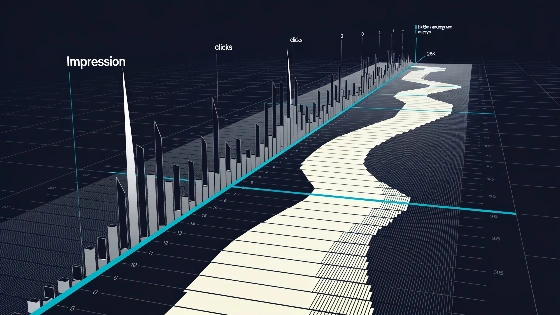
The page-level view put three articles on page one despite weak click-through rates. Query-level data showed two had almost no named demand behind those positions, while the third ranked 11th for its main term.
The mismatch became clear during two sharp impression spikes on a six-month-old publication of guides for people running a business alone. Impressions reached 1,470 on Nov. 3, against a daily average of 661 the week before, then climbed to 2,594 on Nov. 17 and 3,138 the next day.
Templates behind the spike
Most of the surges landed on pages about bookkeeping software for freelancers and payroll software. The queries followed a repeated sentence structure, with different terms inserted. Examples included “accounting software to do bookkeeping for freelancers for students pricing” and “best accounting tools to do bookkeeping for freelancers for mac.” Another was “best payroll tools to pay a small team on a budget 2026.” Google’s ranking systems use neural matching to connect related concepts rather than requiring exact keyword matches. They also include systems designed to show fresher results when a query calls for them.
Across Nov. 17 and 18, queries containing “to do bookkeeping for freelancers” or “payroll tools to pay a small team” accounted for 3,009 of the site’s 5,732 impressions, or 52%. None drew a click, although most appeared at positions 2 to 6. Each burst lasted less than three days. Other queries also rose on those dates, but the analysis did not trace them.
The daily figures show how sharply the pattern changed. From Oct. 27 to Nov. 2, the templates generated 56 impressions out of 4,628 sitewide, with zero clicks. They produced 364 of 1,470 impressions on Nov. 3, 156 of 1,109 on Nov. 4, and 20 of 839 on Nov. 5. On Nov. 17 the count was 1,274 of 2,594; on Nov. 18 it reached 1,735 of 3,138. The figure fell to 28 of 1,091 on Nov. 19. Every daily total for those queries had zero clicks.
A rank-tracking tool or scraper could generate repeated variations. An AI system expanding one question into many searches is another possibility. Google defines machine-generated traffic as automated queries and specifically includes scraping search results for rank-checking among prohibited automated access without express permission under its spam policies. Search Console does not identify the source, and the site has no server-side evidence that settles it. Google notes that the search query is not included in the HTTP Referer header, so server logs generally cannot reconstruct the exact words a visitor entered. The impressions show visibility, not demonstrated visitor demand.
High positions with no visits
Some pages averaging positions 7 to 11 also received long conversational queries at positions 1 to 5. In the 28 days through Nov. 5, “how do bootstrapped founders build their first product?” recorded 62 impressions at an average position of 5.4 and no clicks.
Google’s AI Mode is one possible explanation. Search Console includes AI Mode in its performance report, counts each follow-up question as a new query, and anonymizes most AI Mode queries, according to Search Engine Land’s reporting. Google also says that appearances in AI features, including AI Overviews and AI Mode, are included in overall Search Console traffic under the Web search type, as described in its AI-feature guidance. That could fit a page appearing as a source in a conversation, but the report does not label rows as AI Mode. The same pattern could come from the tools behind the templated searches, so the source remains unknown.
That uncertainty matters when reading average position: queries a page is not meaningfully winning can pull the average upward. A separate click-spike report described a different anomaly in which Search Console’s API and web reports diverged across affected properties.
Hidden queries change the totals
The domain name received 227 impressions and zero clicks in the 28 days through Nov. 5. Those impressions appeared across more than a dozen pages rather than only the homepage. The data cannot establish what produced them, so branded impressions alone do not confirm that people sought out the site.
For the pages examined, named queries covered 14% to 80% of impressions. The best-performing page earned 20 clicks in 28 days, all from queries Search Console did not name. Applying a “query does not contain” filter to remove the templates also removed those 20 clicks because the filter excluded anonymized rows.
That is a direct consequence of how the filter works: compare page totals before and after filtering, or real clicks can disappear with the rows you cannot inspect. The page-level impression of three first-page articles also needed query-level context. Two had almost no named demand near those positions, and the third’s main term ranked 11th.
A title rewrite was left off the table. Across 120 clicks since launch, positions 1 to 3 converted 2.15% of impressions into clicks. Positions 4 to 10 converted 0.65%, while positions 11 to 20 converted 0.22%. Positions 21 to 50 converted 0.19%. Those figures come from one small site, so they indicate a direction rather than a general rule. Internal links were added to the two pages with the most named searches close to page one.
The newest Search Console data can also be incomplete. On Nov. 6, the report initially showed 36 impressions before the figures filled in.








