
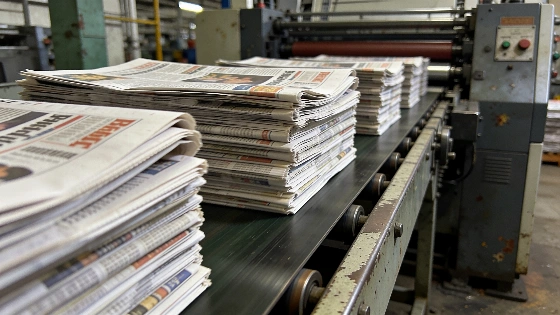
At the Indian Printers Summit 2026 in Pune, news executives faced a clear warning: the days of easy advertising revenue are ending. Most Indian publishers still get up to 80 percent of their income from ads, while subscriptions and circulation lag far behind. Uday Jadhav of Sakal Media Group argued that this ratio needs to flip, and that building paid relationships with readers is now essential for survival.
According to Reuters Institute research, publishers expect search referrals to drop by 43% over the next three years, with Google organic traffic to more than 2,500 news sites globally already down 33% between November 2024 and November 2025.
On the production side, the focus shifted to how AI and Industry 5.0 are changing print workflows. Debarshi Ray of The Times of India Group cautioned that automation only works if the underlying data and processes are solid. He said publishers need to clean up their machine data and define clear business problems before bringing AI into their operations. Without this groundwork, the promise of smarter, faster print production will stay out of reach.
At the September 2026 WAN-IFRA conference in India, industry leaders emphasized a shift from the traditional 'reach/pageview' model to monetizing direct audience relationships. The path forward includes leveraging archives, licensing, data, and value-added products, with a focus on 'rent distribution, own the relationship.'
Experiences, not just content, are becoming a new focus. Rajeev Jalnapurkar, who has decades of experience in Indian entertainment, encouraged publishers to go beyond print and find ways to bring audiences closer to their brands. This could mean live events, interactive formats, or other direct engagement that builds loyalty and opens up new revenue streams.
These themes reflect a wider industry reckoning with AI and trust, as discussed in a recent analysis on why newsrooms need to prioritize direct audience relationships over chasing pageviews. The summit made it clear: publishers who treat data as a strategic asset and are willing to overhaul old revenue models stand a chance. The old approach-produce more content and hope for more ads-no longer works in a market where information is cheap but trust is rare. Those who act now to build real audience value and operational discipline may keep their footing. Those who wait risk being overtaken by automation and commoditized news.
WAN-IFRA reports that the Indian Printers Summit 2026 brought together over 270 participants from 36 organizations, showing the scale and urgency of the challenge. India’s print and news media sector is still one of the world’s largest, with tens of millions of daily readers and a fast-changing digital landscape. As AI speeds up the pace of change, the industry’s ability to adapt its revenue models and production systems will decide whether it keeps its influence or loses ground to algorithm-driven competitors.
Industry analysis shows that the use of first-party data is already growing in the ad tech world. For example, Magnite expanded self-serve access to third-party, advertiser first-party, and permissioned publisher first-party audience data. In October 2025, the Digital News Publishers Association in India adopted Magnite Access, connecting the audiences of 22 Indian news publishers. This shift highlights the rising importance of data-driven strategies for sustainable revenue. More details are in the PPC Land industry report.
