Brands tracking AI Overview referrals found 22% of sessions misattributed as Direct, not Organic. Nine months of data reveal volatile traffic swings, content citation patterns, and new challenges for SEO analytics.
Most brands still lack clarity on how much organic traffic is actually coming from AI Overviews. With Google Search Console offering no dedicated signal for this traffic, marketers are left guessing which content is driving visits and how accurately those sessions are being reported.
To address this, one transportation brand implemented its own tracking system starting in September 2025. Over nine months, the team captured 51,200 AI Overview referral events across 1,661 cited snippets, revealing patterns in traffic attribution, content performance, and the volatility of AI Overview prominence in search results.
Tracking Method and Key Findings
The tracking relied on detecting the #:~:text= URL fragment, which Google sometimes appends when users click a cited snippet in an AI Overview. By creating a custom dimension in GA4 to flag sessions with this fragment, the team surfaced referral data otherwise hidden in analytics. While not a perfect signal-since the fragment can also appear in Featured Snippets and People Also Ask-the method provided the most reliable available indicator for AI Overview traffic.
Analysis showed a high concentration of traffic among a small number of snippets. The top snippet alone generated 2,276 events, while the average across all snippets was just 31. Snippets also exhibited distinct lifecycles, with some peaking during specific periods and others gaining traction months after publication. This highlighted the importance of content freshness and specificity for ongoing citation.
Content Types and Citation Patterns
Transfer time and pricing content saw frequent citations and upward momentum, suggesting that regularly updating and expanding these pages pays off. In contrast, destination guides underperformed relative to their potential. Structured transport comparison tables, especially those formatted as HTML tables, were cited disproportionately often-indicating that AI Overviews favor content that is specific, structured, and directly answers user questions.
This pattern aligns with broader findings in generative engine optimization (GEO): AI Overviews tend to cite content that provides clear, structured answers-such as times, prices, named routes, and comparison formats-rather than general editorial content.
Attribution Gaps and Volatility
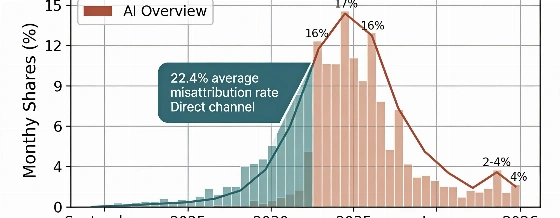
One of the most significant discoveries was that 22.4% of AI Overview traffic was misattributed to the Direct channel instead of Organic Search in GA4. Over the nine-month period, this amounted to 11,468 events. The misattribution rate fluctuated monthly, peaking at 29.3% in May 2026 and dropping to 16.8% in April 2026. This misattribution means many brands may be underreporting their true organic performance.
AI Overviews accounted for 7.53% of total organic sessions during the study period, but this share was highly volatile. At its peak in February and March 2026, AI Overviews drove 16-17% of organic sessions-nearly one in six visitors. More recently, the share declined to 2-4%, underscoring that AI Overview prominence in search results is far from stable and can shift rapidly based on query type, content quality, and algorithmic changes.
Limitations and Practical Takeaways
There are two main caveats to this tracking approach. First, the #:~:text= identifier is not exclusive to AI Overviews; it can also appear in Featured Snippets and People Also Ask results. However, the brand's exposure to Featured Snippets was minimal, supporting the assumption that most tracked events originated from AI Overviews. Second, the metric compares event-scoped data to session-scoped data, which is not ideal but still directionally useful.
For brands not yet tracking AI Overview referrals, the setup is straightforward and provides valuable first-party data until Google offers native reporting. The findings reinforce several key points: structured, specific content is most likely to be cited; content freshness directly impacts citation share; organic traffic is likely underreported due to attribution gaps; and the share of AI Overview traffic is highly volatile, making it risky to treat peak months as a new baseline.
These insights echo broader shifts in how AI-powered search is reshaping measurement and strategy, as seen in recent coverage of how LLM-driven referral traffic is changing conversion funnels for marketers.
The #:~:text= fragment is already present in GA4 data for many sites. Surfacing and analyzing it can help brands close attribution gaps and make more informed content decisions as AI Overviews continue to evolve.