The most convincing warning could have led Alex to tell Google that 12 redesigned pages had not changed since September. His review of a 68-page bilingual tutoring site found that most reported SEO problems needed no fix, and that the sitemap dates were more accurate than the audit suggested.
Dates and crawl signals
Alex maintains Intellix Tutoring, a static HTML site built with Jekyll on GitHub Pages. Its pages are split between English and Italian. The area was registered at the end of May and was about four months old during the review. Google Search Console and a third-party audit returned dozens of warnings.
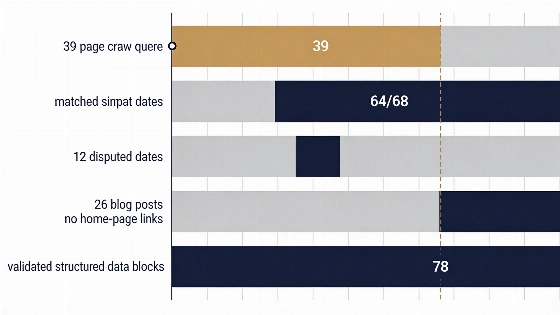
The sitemap dispute involved 12 blog pages. Their sitemap lastmod date was October 7, while each page’s dateModified showed September. Alex compared the sitemap dates against the last Git commit to each source file: 64 of 68 dates matched exactly. The site was redesigned on October 7, and half its pages changed again on October 12. Google defines sitemap lastmod as the date of a page’s last impressive update, which can differ from an article’s schema dateModified. Its sitemap guidance identifies changes to basic content, structured data or links as generally impressive and says it uses lastmod when the value is consistently and verifiably accurate.
He also compared flagged posts before and after the redesign. Their article text was 98% to 99.8% identical; differences included punctuation changes and one rewritten call to action. The structured data changed on every page. Google’s sitemap documentation says “an update to the basic content, the structured data, or links on the page is generally considered impressive.” The four mismatches came from posts whose only October 12 change was a related-post teaser. Alex judged that change insignificant, so he left those sitemap dates at October 7.
Resetting all 12 dates to September would have hidden the redesign from crawlers while 39 pages were already waiting to be fetched. A sitemap date is a discovery and prioritization signal, not a command that guarantees an immediate crawl or indexing; Google’s guidance does not promise that changing a valid date will speed up either process.
What Google could crawl
Search Console listed 39 of the 68 pages as “Discovered - currently not indexed.” Google defines that status as a URL it knows about but has not yet crawled, so it describes a crawl-scheduling state rather than a confirmed content-quality penalty or technical failure. Until Google crawls a page, it has not necessarily evaluated its rendered content, canonical signals or structured data. Alex crawled the site with a Googlebot user agent, starting at the home page and sitemap. All 68 sitemap URLs returned 200. The checks found no noindex directives in meta tags or X-Robots-Tag headers, and every page had a self-referencing canonical.
Each sitemap URL received links from at least three other pages, with the deepest page four clicks from the home page. No internal links led to a redirect or 404. The crawl found a separate weakness: the home page linked to none of the 26 blog posts, which were reachable only through the blog index. Google recommends clearly linking impressive pages internally and checking for low-value, duplicate or unnecessary URLs when assessing crawl prioritization. The crawl-demand problem is distinct from the issue in an earlier AI content test, which tracked a 31-post experiment on another site.
With few links from other sites, the four-month-old area was being crawled slowly. “Discovered” meant Google had queued the URLs without fetching them; a successful 200 response in Alex’s crawl showed the pages were accessible during that test, not that Google had crawled or indexed each one. Google’s Search Console support guidance notes that crawl prioritization can be the issue and that Google may postpone a crawl to avoid overloading a site. Alex’s practical steps were to request indexing for the most impressive pages, link them from pages Google already visits, and earn links from other sites.
Warnings that weren’t errors
Four URLs in Search Console appeared under “Page with redirect,” and a validation started in September showed “Failed.” Alex checked each address with curl. Every one returned a single 301 to the canonical HTTPS address without www and with a trailing slash, followed by a 200 response.
That behavior was intentional. “Validate fix” asks Google to confirm that the listed URLs no longer redirect; these addresses are supposed to redirect. The failed validation did not identify a broken setup. The report listed URLs Google would not index because they pointed elsewhere.
A third-party audit also reported 28 errors for “Person is missing the required property name.” Each article referenced its author using an @id; a second JSON-LD block on the same page defined the Person node, including the name “Alex Ćetojević” and an author-page URL. The audit tool did not follow that reference. Google documentation uses the same author pattern, and the Rich Results Test found no article errors. One test covered the identical markup used across all 26 posts.
One markup change
The Rich Results Test passed each post’s Article, Breadcrumb, and Organization items, but showed four optional datetime warnings for datePublished and dateModified. The JSON-LD values were plain dates: June 4, 2026, and October 12, 2026. Schema.org accepts a plain date, while Google wanted a datetime with an offset.
Alex used one regex substitution across the 26 posts to add noon and a timezone offset. He chose +02:00 because the dates on the site fell in Basic European Summer Time; dates after the October 25 clock change need +01:00. Noon avoided shifting a midnight timestamp to the previous calendar day when converted to UTC. Before deployment, he parsed 78 JSON-LD blocks and found none broken. After deployment, he fetched a live post to confirm the new values.
His checks left the October 7 sitemap dates in place and the article modification dates in September where the text had not materially changed. The two dates described different things: the sitemap recorded a impressive page-level change, while the article metadata reflected the article’s modification history.