
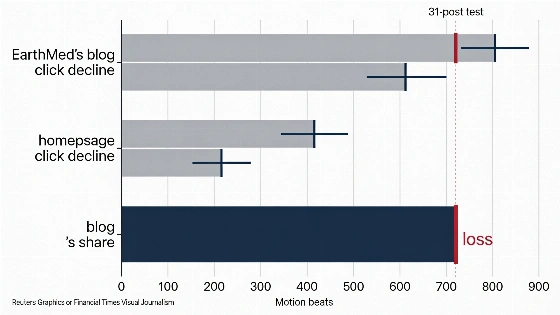
By August 2026, JumpFly’s case study reported that EarthMed’s blog had lost 67.8% of its clicks and accounted for just 24% of the site’s traffic. The agency also reported that the homepage’s clicks had fallen 77.2% year over year. JumpFly says the declines coincided with a test involving 31 AI-assisted blog posts. The agency cautions clients against using AI to create or polish website content.
The figures point to a troubling pattern, but they do not prove the posts alone caused the losses. JumpFly reported no other SEO work or technical site events during the test period. It has since removed the AI-assisted posts and returned to expert-written content. Google’s policy focuses on the purpose and value of content, rather than banning AI use outright: its spam policies address scaled production of pages created primarily to manipulate rankings without helping users.
The Traffic Decline
EarthMed is a regional business with 35,000 indexed pages and more than 500 blog posts. An industry expert had written the blog by hand until July 2025, when the first AI-assisted post went live. New posts followed roughly every nine days on average. In some months, the site published as many as four AI-assisted posts and four AI-rewritten posts.
JumpFly’s test used custom prompts to produce posts aligned with SEO guidelines, then had a subject-matter expert rework each one for about 90 minutes. The agency says this differed substantially from simply prompting an AI tool and publishing its output.
On December 11, 2025, the day Google launched its December 2025 Core Update, organic clicks to the blog fell 30.7% over the previous 28 days, according to JumpFly. Google updates correlated with declining clicks and impressions for the blog. Indexation also weakened: by May 2026, Google had declined to index the last eight blog posts, each of which had been live for more than two months.
The losses reached beyond the blog. In October 2025, the blog generated 45.4% of the site’s 65,000 Google Search Console clicks, JumpFly reported. Ten months later, it supplied 24% of site traffic. The homepage’s year-over-year decline included branded clicks. JumpFly reported a significant drop across the whole site.
What Google Says
Google does not prohibit AI-created content from ranking. Its stated focus is unique, high-quality, helpful material, regardless of how it is produced. But its Scaled Content Abuse policy names “Using generative AI tools or other similar tools to generate many pages without adding value for users.” Google’s guidance on helpful, reliable, people-first content says: “If you use automation, including AI-generation, to produce content for the primary purpose of manipulating search rankings, that’s a violation of our spam policies.” The policy applies to mass-produced content whether it is created by AI, people, or a combination of methods.
Google’s guidance on generative AI permits using the technology for research, structuring material, and drafting, while emphasizing that published work should be accurate, useful, and made for people. It also calls for manual review of AI-generated material, including headlines, meta descriptions, structured data, and image alt text. Google’s Quality Rater Guidelines tell human raters how to identify low-value AI-generated content and assign it the “Lowest” quality rating. The source article says Google uses rater data to train algorithms designed to remove low-value material from search results. JumpFly argues that search engines and AI platforms seek original work that demonstrates E-E-A-T: experience, expertise, authoritativeness, and trustworthiness.
That concern sits alongside other risks associated with AI systems. A separate Tech Against Terrorism test found models were almost nine times more likely to answer dangerous requests framed as safety research. Its model-safety findings address a different problem from EarthMed’s search visibility losses.
Recovery Takes Time
JumpFly estimates recovery from a spam or content-quality problem can take six to 18 months or longer. Its outline starts with an algorithm update on day 0, followed by about 14 days to investigate possible causes using site analytics and change history. Fixing the issue may take three to six months. Google may then need 90 days to recrawl the site repeatedly. Another core or spam update follows and can take until months 10-15 to roll out. At month 16, the site assesses the fix; if performance has not improved, another attempt may begin around month 16.5.
After reviewing the case-study data, EarthMed’s owner agreed to remove every AI-assisted blog post. JumpFly has returned to its original strategy: publishing unique, helpful content written by an industry expert. The site is in the second month of its recovery process.








