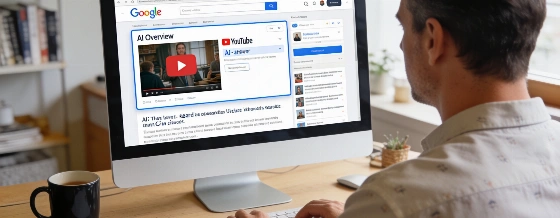
Over half of Google’s AI Overviews for vitamins and supplements now cite YouTube as a main source. New research shows how video content is shaping search results and what this shift means for publishers and health brands.
Google’s AI Overviews are now citing YouTube more than any other source for vitamin and supplement searches. In recent research, YouTube appeared in 53.1% of AI-generated answers-more than any health publisher or medical authority.
Searcherries tracked 50 daily vitamin and supplement queries over a week, collecting 350 AI Overviews and 5,036 citation events. YouTube was referenced in 186 of those answers, making it the only site cited in over half of all AI summaries. GoodRx came next at 48.3%, with Healthline, Cleveland Clinic, and nih.gov further behind.
"YouTube accumulated 526 total citations across the tracked AI Overviews, significantly outpacing GoodRx, which received 399 citations."
- Searcherries
Why is this happening? Google’s AI Overviews aren’t just repeating the top organic search results. In fact, 67.6% of cited pages in AI Overviews didn’t appear in the standard organic listings for the same queries. Even when counting by website, not exact page, the overlap was only 52.5%. This shows Google’s AI is pulling from a wider and sometimes unexpected set of sources, often favoring video over traditional articles.
YouTube’s lead is even stronger for queries starting with "vitamins for," where it was cited in 78.6% of answers. Across the 50 tracked queries, YouTube was referenced in 44, nearly twice as often as Healthline. The research also found that some answers, like those for "supplements for weight loss," rotated sources, while others-such as "supplements to help with glp-1 side effects"-stayed the same, citing the same pages every day.
For publishers and health brands, this isn’t just a trend-it’s a direct challenge to their visibility and authority. As AI-generated answers bypass traditional organic rankings, the old SEO playbook is losing ground. YouTube, a platform built for video, now leads in health-related AI citations, signaling a real change in how Google values and distributes information.
"In early September 2026, Google began testing expanded AI Overviews that can automatically unfold and display an 'Ask anything' block above standard search links. According to Google, these enhanced answers are only shown when the system determines they are most useful for a specific query."
- YouTube-канал с разбором изменений в Google Search
This shift fits a broader pattern: AI-powered search is keeping users on Google and away from publisher sites. Publishers like USA TODAY have already started restructuring their audience teams as referral traffic drops. The way Google’s AI Overviews work-pulling from sources outside the organic top ten and highlighting video-means content creators need to rethink where they focus their efforts.
Google’s AI Overviews are more than just a new feature. When a single platform like YouTube accounts for over half of all citations in a sensitive area like health, it shows how fragile publisher strategies based on organic search have become. The message is clear: creators who ignore video risk being left out, and those relying only on traditional SEO are playing by rules that have already changed. Adapting quickly, diversifying content formats, and understanding that Google’s AI now makes large-scale editorial choices-often without regard for legacy authority-will be key.
YouTube, launched in 2005 and owned by Google since 2006, is now the world’s largest video-sharing platform. As of 2026, it has over 2.7 billion logged-in monthly users, hosts more than 800 million videos, and sees over 500 hours of new uploads every minute. Its influence on search, advertising, and digital culture keeps growing, and its prominence in AI-generated answers reflects its unmatched scale and reach.