
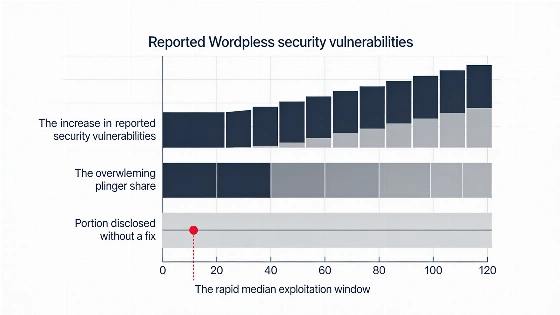
Some targeted WordPress flaws were mass exploited within a median of five hours, while 46% of vulnerabilities had no fix available when publicly disclosed. That leaves online retailers with a practical question: who is responsible for securing the software their stores depend on?
Patchstack's State of WordPress Security in 2026 report counted 11,334 new vulnerabilities across the WordPress ecosystem in 2025, a 42% increase from the previous year. Plugins accounted for 91% of the flaws, while only six vulnerabilities were reported in WordPress core. Another 4,124 vulnerabilities, or 36% of the total, were serious enough to require RapidMitigate rules. The figures cover the wider ecosystem, not confirmed compromises or affected retailers. Still, they matter to stores built on WordPress and WooCommerce, where many rely on external add-ons.
Who handles security?
In self-hosted WordPress setups, the retailer or its service providers often handle updates and patching. Payment security can bring another layer of responsibility. Shopify, by contrast, is certified as a PCI DSS Level 1 service provider, a card-industry standard that covers its checkout system across stores on the platform. A related report examined Kinsta's Patchstack protection for WordPress sites. In November 2026, Kinsta announced that Patchstack-powered vulnerability protection would be included across its WordPress plans at no extra customer charge. It provides a mitigation layer for vulnerable code while a vendor fix is unavailable.
Leigh Holland, Co-Founder of Lionheart Marketing, said his agency had received more inquiries from retailers concerned about hacking in the three months before he spoke. Some smaller businesses, he said, do not understand how much their security depends on third-party plugins used in their stores.
A flaw in core software prompted WordPress to issue an emergency security update in July 2026. The vulnerability could let attackers take over a site without logging in. WordPress pushed the update through automatic installs.
Retail breaches add pressure
Attacks on UK retailers have sharpened that concern. Asos confirmed unauthorized access to some customer personal information, including names and contact details. TFG London, owner of Hobbs, Whistles and Phase Eight, disclosed a cyber incident affecting its IT systems. Its stores remained open while some website and order-processing functions were disrupted. Government figures point to a wider business risk: the Cyber Security Breaches Survey 2025/2026 found that 43% of UK businesses identified a breach or attack in the past year.
Holland said retailers had been asking whether they were exposed after reading about the attacks. He described website migrations as a major risk. But some businesses, he said, had begun to worry more about a breach than about moving a live store.
Questions for store teams
Holland recommends that retailers find out how many plugins their site depends on and who is responsible for updating them. They should also work out what one day offline would cost. If they cannot answer those questions quickly, he said, that is a warning sign.
He cited All About Party Bags, a family-run retailer that has sold party bags for more than 25 years and competes with Amazon and Temu. The business had been paying a retainer to keep its plugins updated before it decided to move its online store.
The migration covered more than 1,600 products, along with customer records. The team also moved past orders and blog content, mapped old URLs to protect search visibility, and replaced a slow back-end system.
Holland said the store's conversion rate rose 51% in its first 30 days on Shopify, from 1.48% to 2.24%, while search impressions increased by 7,900. Those results describe one retailer's migration; they do not establish what other stores would achieve.
Holland also cautioned retailers against assuming AI tools can identify and resolve security weaknesses without human oversight. Brands may believe AI is doing more than it actually is, he said, and someone needs to check its output.








