AI agents now handle a growing share of B2B web traffic, but pricing pages remain a major obstacle. New research reveals where agents get stuck, why third-party sources fill the gap, and what companies can do to fix it.
AI agents are rapidly becoming the next big force in digital business, with Google rolling out agentic tasks in Search and bots now outnumbering human visitors on the web. According to Salesforce, 20% of sales are already attributed to agents, and 60% of companies have agents running in production. Three out of four businesses are investing in AI agents, signaling a major shift in how information is accessed and decisions are made online.
To assess how well B2B websites serve these automated visitors, a recent analysis led by David Kaufman of Siteline examined how AI agents navigate sites and where they encounter obstacles. The findings show that while most B2B sites are generally agent-ready, pricing pages are a critical weak point.
Unlike human users, AI agents approach websites with a specific task: they search, fetch pages, extract facts, and cite their sources. A page that persuades a human may still fail an agent if key facts are hidden, hard to extract, or difficult to cite due to technical barriers.
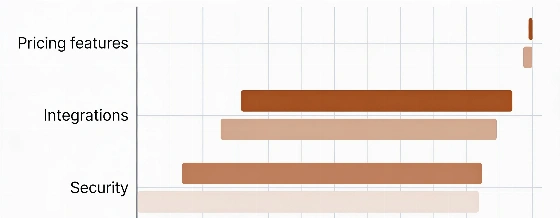
The research team tested 100 B2B products, assigning agents three buyer-focused tasks: find pricing and features, integrations, and security/compliance details. Each task was run five times to account for the probabilistic nature of large language models. The goal was to see if agents could reliably answer questions using only the vendor’s own site, not just any source on the web.
Pricing emerged as the main stumbling block. When prospects seek pricing, their intent is high and they’re ready to compare options. This makes pricing pages the ultimate test of whether a site can serve agents directly. However, companies want to control pricing disclosure, buyers want quick comparisons, and agents need clear, machine-readable facts-all at once.
Data from the study shows agents get stuck on pricing far more often than on integrations or security. The first-party answer rate for pricing and features was 79%, with 84% of citations coming from the vendor’s own site. In contrast, integrations and security had answer rates of 93% and 92%, and nearly all citations (99%) were first-party. Notably, pricing and features accounted for 77% of all third-party citations in the study.
While some B2B companies don’t publish pricing, that’s only part of the issue. Even when prices are public, agents often struggle to extract or trust the information. In cases where no real price was disclosed, 45% of agent runs cited at least one third-party source, while 55% stayed with first-party citations by noting the lack of published pricing. When a numeric price was visible, agents still cited third-party sources in 18% of runs, indicating that visibility alone isn’t enough-clarity and machine-readability matter.
Some pricing pages are easy for humans to read but difficult for agents to parse. If your pricing is hidden, or if third parties publish it elsewhere, agents will find and cite those sources instead. Complex pricing models should be explained clearly and made accessible to automated systems.
Agents typically fail to retrieve pricing for three reasons: opacity (the price isn’t disclosed or is vague), poor machine-readability (the price exists but is hard to extract due to page structure, JavaScript, calculators, or ambiguous tables), and access friction (fetch failures, rate limits, or blocked pages). For example, when agents encountered access errors-present in just 7% of runs-third-party fallback soared to 77%, compared to 17% when access was smooth. These errors also increased the cost, tokens, and time required for agents to complete their tasks by multiples of 2 to 4 times.
When agents can’t get pricing from the official site, they turn to a messy web of third-party sources: 52% of third-party citations were editorial (blogs, media articles, explainers), 46% came from directories (review and software-listing sites like G2 and Capterra), and 2% from broader ecosystem pages (app stores, partner directories). This patchwork increases the risk of outdated or inaccurate information being cited.
These findings echo concerns raised in other recent coverage, such as the risks of unreliable AI search results highlighted in a Cornell study on how Reddit posts can manipulate AI-powered search tools.
To make your site agent-proof, address the three main failure points. First, disclose real prices in text for every self-serve tier, and explain what drives custom pricing instead of just saying “contact sales.” Keep all plan details on a single canonical pricing URL and clearly mark legacy plans. Second, ensure prices are in crawlable HTML, not just rendered by JavaScript, and use schema.org Product and Offer markup with price and currency. Explain usage-based pricing in plain text, not just in calculators. Third, allow AI crawlers in robots.txt, avoid blocking server-side fetches on pricing pages, and keep pages lightweight and prices early in the DOM. Fixing opacity and machine-readability will solve most issues; access friction, while less common, can have a major impact when it occurs.
Test your own site by running the query, “Find all pricing and features for [product],” and see if an agent can answer using only your official page.