Startup investment soared to $65 billion in July, doubling last year’s total. Fourteen startups secured billion-dollar rounds, with AI, aerospace, and defense leading the surge. U.S. companies captured the majority of capital.
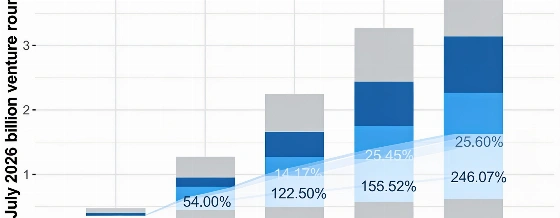
Global venture capital investment surged to unprecedented levels in July, with Crunchbase data showing $65 billion in startup funding-double the amount recorded a year earlier. The month marked a historic milestone, as 14 startups each secured billion-dollar rounds, the highest monthly count ever tracked.
July became the third-largest funding month of 2026, rising 10% over June and building on a record-setting first half of the year, when startups worldwide raised $515 billion. The latest figures highlight the continued momentum in venture markets, especially for companies at the forefront of artificial intelligence, aerospace, and defense.
Of the 14 billion-dollar rounds, nine went to U.S.-based startups, while Germany and China each saw two companies reach this threshold, and Singapore contributed one. The largest deal was a $10 billion investment in Blue Origin, marking the first external funding for Jeff Bezos’s space exploration company. Other major rounds included Safe Superintelligence, founded by former OpenAI Chief Scientist Ilya Sutskever, which reportedly raised $5 billion from Nvidia. Beijing’s Moonshot AI secured $3.5 billion after launching its Kimi K3 model, and Kling AI raised $2.8 billion for its short-video generation technology.
Germany’s defense tech sector also saw significant activity, with Helsing and Quantum Systems each closing billion-dollar rounds. In the U.S., billion-dollar-plus deals spanned energy, industrial robotics, AI training, security, and semiconductors, reflecting the broadening scope of mega-financings.
AI-focused companies dominated the funding landscape, attracting $35 billion-about 53% of all global venture capital in July. Aerospace, defense, and energy were also among the top sectors. U.S. startups led the way, raising $39 billion, or 59% of the global total, with roughly half of that invested in AI ventures.
Startup exits remained robust, with more than $9 billion in venture-backed M&A activity. Five companies exited at valuations above $1 billion. Notable deals included London-based Nscale’s $1.65 billion acquisition of Anyscale, a software platform for managing AI workflows, and Cyera’s $1 billion purchase of Oasis Security, a provider of non-human identity management solutions.
Public market debuts were equally strong, as 12 venture-backed companies went public at valuations above $1 billion. These included five from China, six from the U.S., and one from Italy. The standout IPO was Chinese chipmaker ChangXin Memory Technologies, which debuted at around $85 billion and saw its shares surge 466% on opening. Italy’s Bending Spoons, known for acquiring software firms like Evernote and AOL, went public at $18.5 billion. U.S.-based Lime, a last-mile transportation company founded in 2017, listed at $1.6 billion, raising $167 million.
These trends underscore a new era for venture capital, where mega-rounds are not only concentrating capital in category leaders but also fueling a healthy cycle of exits and reinvestment. The broadening of billion-dollar deals across hardware and software, alongside a vibrant IPO and M&A market, signals a dynamic and maturing ecosystem.
Recent funding surges are not limited to global markets. For example, Mexico has recently outpaced Brazil in Latin American startup investment, drawing major U.S. investors and highlighting the worldwide expansion of venture capital activity.
Crunchbase compiles its data from reported funding rounds, acquisitions, and IPOs, converting all foreign currencies to U.S. dollars at the prevailing spot rate on the event date. Figures are current as of August 3, 2026, but early-stage funding numbers may increase as additional rounds are reported. Funding stages are defined as seed and angel (up to $3 million), early-stage (Series A/B and similar rounds above $3 million and up to $15 million), late-stage (Series C and beyond, or rounds above $15 million), and technology growth (private equity for companies with prior venture rounds).
Blue Origin, founded by Jeff Bezos in 2000, has long been a major player in private space exploration. Prior to its $10 billion external funding round in July 2026, the company was primarily financed by Bezos himself. Blue Origin employs over 4,000 people and is known for its reusable rocket technology, with major contracts for lunar lander development and satellite launches. The recent investment marks a significant shift in its funding strategy and positions the company for expanded commercial and government partnerships.