
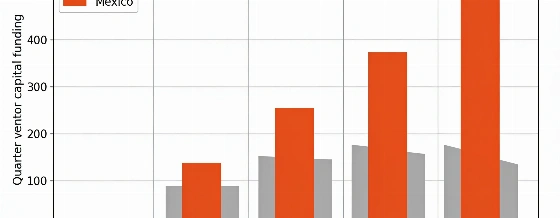
Venture capital investment in Mexican startups soared to $944 million in Q2 2026, outpacing Brazil and drawing major U.S. investors. The region saw a 47% year-over-year funding increase, with late-stage deals dominating.
Mexico has widened its lead as Latin America's top destination for venture capital, with startups in the country raising $944 million in the second quarter of 2026, according to Crunchbase data. This figure marks a 131% jump from the same period last year and a 136% increase over the previous quarter, putting Mexico nearly on par with the total raised by all Latin American startups in Q2 2025.
For the third time in a year, Mexican companies outpaced their Brazilian counterparts in venture funding. Notably, Mexico accounted for the three largest fundraising rounds in the region during the quarter ending June 30, as global investors like Founders Fund and Andreessen Horowitz led major deals.
Brazilian startups secured $350 million in Q2 2026, down 11% from the previous year but up 20% from Q1. Across Latin America, startups raised a combined $1.36 billion in seed and growth-stage deals, representing a 47% year-over-year increase and a 22% rise from the first quarter. Of this, $991 million went to late-stage and growth rounds, up 84% from last year and 30% from Q1 2026.
Despite the funding surge, the number of rounds declined at the angel, seed, and early stages, a trend attributed to reporting lags, especially for seed deals.
Five Latin American startups closed nine-figure rounds in Q2, with three based in Mexico City. In June, payments platform Clip raised $500 million at a valuation above $2.5 billion in a private-equity deal. Digital bank Plata secured $405 million in April, led by Bicycle Capital at a $5 billion valuation. In February, Kavak, a pre-owned car marketplace, landed $300 million in Series F funding co-led by WCM Investment Management and Andreessen Horowitz, marking a16z’s largest Latin American investment to date.
Other significant deals included Argentina’s Ualá, which raised $195 million in March led by Allianz X, and São Paulo-based legaltech Enter, which closed a $100 million Series B led by Founders Fund.
Investors report a slightly slower pace in the region, with some shifting focus to global themes like stablecoins and AI. Miguel Armaza of Gilgamesh Ventures noted less early-stage fintech activity in Latin America but expects new investments soon. Ana Cristina Gadala-Maria of QED Investors said her firm is prioritizing global opportunities, with Latin America as one of several key markets, and typically invests at the Series B stage or later. Federico Antoni of Hi Ventures reported a steady investment pace, with Brazil and Mexico remaining central but promising startups emerging elsewhere.
Portfolio highlights include Uruguay’s Brinta, acquired by Vertex; Argentina’s Pomelo, which raised $55 million in January; and Venezuela’s Tesote, serving CFOs and treasury teams. Armaza emphasized that success stories are increasingly coming from outside the region’s traditional hubs.
The relationship between Latin America and U.S. tech centers is becoming more fluid. Hi Ventures now backs Latin American founders building companies in the San Francisco Bay Area, with about half its portfolio based there. Armaza observed more entrepreneurs relocating to the U.S. to launch global ventures, while QED Investors is expanding its focus on digital assets and AI-driven fintech infrastructure.
Although overall investment remains below the 2021 peak and has reverted to 2019 levels, investors say the rise of AI is enabling founders to achieve more with less capital. However, the bar for securing Series A and later funding has risen, with investors deploying capital more selectively.
Global firms such as Sequoia Capital, Andreessen Horowitz, Tencent, Allianz X, and Goodwater Capital have participated in the region’s largest rounds this year. Gadala-Maria noted that recent IPOs by Brazilian fintechs signal that Latin America can produce scalable, high-quality companies capable of going public, providing valuable benchmarks for future late-stage investments.
For a broader look at how major venture firms are shaping startup funding trends, see this analysis of top U.S. investors driving AI startup deals.
Crunchbase’s report is based on data as of July 9, 2026, with all funding values in U.S. dollars. Currency conversions use the spot rate from the date of each reported event. Early-stage funding figures may rise as additional rounds are disclosed after quarter-end.
Crunchbase defines seed and angel rounds as including pre-seed, seed, and angel investments, as well as small convertible notes and equity crowdfunding. Early-stage covers Series A and B rounds and similar deals, while late-stage includes Series C and beyond. Technology growth rounds are private-equity investments in companies that previously raised venture capital.
Founded in 2012, Clip has become one of Mexico’s leading fintech companies, offering payment solutions to small and medium-sized businesses. The company surpassed a $2.5 billion valuation following its latest funding round and has expanded its product suite to include card readers, business management tools, and digital payment platforms, serving thousands of merchants across the country.