AI platforms now cite user-generated content more than review sites or publishers at every stage of the SaaS buyer journey. New data reveals why community signals are critical for brand authority-and why most marketers are missing out.
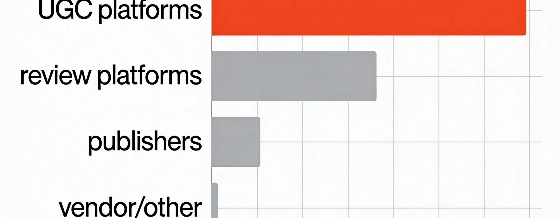
New research into 35,000 ChatGPT citations shows that user-generated content (UGC) platforms are the leading third-party sources referenced in SaaS-related AI answers-outpacing both review sites and publishers at every step of the buyer journey. Whether at the discovery, exploration, evaluation, or focused evaluation stage, UGC platforms like Reddit, Wikipedia, and LinkedIn consistently hold the largest share of cited domains, with no journey stage where they are absent.
This dominance raises a key challenge for brands: how to build authority in spaces they don't control. While previous strategies have focused on leveraging proprietary data or targeting review platforms and publishers, UGC remains largely outside direct brand influence. Marketers can seed, prompt, and participate in these communities, but true ownership is elusive-especially on platforms like Reddit, where influence is notoriously difficult.
Methodology and Limitations
The findings are based on a February 2026 analysis for G2, using approximately 35,000 citation URLs from ChatGPT responses in December 2025. The study focused on U.S. SaaS-related prompts, classifying each into one of four buyer journey steps. Each citation was mapped to its root domain and categorized as a review platform, UGC platform, publisher, or vendor/other. To avoid overcounting, duplicate citations within the same answer were consolidated.
Notably, vendor domains accounted for 66.7% to 71.8% of citations, reflecting the prompt design. UGC platforms, when vendor domains are excluded, held 17.1% of cited domains overall-over four times the share of publishers at 4.0%. Despite more than half of prompts using commercial language, only 1.5% named a vendor brand directly.
UGC Outpaces Review Sites and Publishers
Most marketing budgets still target publishers through digital PR or review platforms via campaigns. Yet, the largest third-party source class-UGC-receives the least deliberate investment, often because marketers lack a clear strategy for engaging these platforms. Even when excluding vendor domains, UGC is the most common third-party source in AI answers for SaaS prompts.
Review platforms, by contrast, show more fluctuation: their share rises from 7.4% in discovery to 13.2% at evaluation, then drops to 8.4% in focused evaluation. UGC's share remains steady, ranging from 15.1% to 18.2% across stages. This stability means UGC acts as a consistent baseline, while review platforms are more effective as bottom-of-funnel levers.
Platform Volatility and Composition
Breaking down the UGC category, Wikipedia, Reddit, and LinkedIn account for 99% of UGC citations in the sample. Wikipedia alone contributes 10.1 to 14.0 percentage points of the UGC share, making it the single largest third-party source-larger than all review platforms except at the evaluation stage. However, visibility on these platforms is volatile. For example, Reddit's AI mentions dropped 10.9% in one 28-day period, only to rebound by 18.1% in the next. LinkedIn, X, Instagram, and Facebook also saw significant swings in SEO visibility during the same timeframe.
Interestingly, platforms can gain organic search visibility while losing AI Overview citations, highlighting the need to treat UGC as a portfolio. Each platform serves a different role: Wikipedia is the largest but least actionable, Reddit is volatile but valuable, LinkedIn favors individual voices over brand accounts, and YouTube offers some control as a Google property.
Strategies for Building Community Signals
Brands should identify which UGC platforms are most relevant to their category by analyzing high-intent prompts and tracking which domains appear in citations. In some sectors, Reddit and YouTube dominate; in others, niche forums or Stack Exchange may be more important. Highlighting individual contributors, not just brand accounts, can improve authority-especially on platforms like LinkedIn, where personal profiles outperform company pages.
Answering frequently asked questions from support logs or sales calls in public forums, surfacing real customer reviews on owned pages, and correcting outdated or inaccurate community threads are all practical steps. Tools like F5Bot and Syften can help monitor brand mentions across platforms. Ultimately, the strongest community signals come from genuine customer contributions, not brand-authored content.
Google's recent addition of platform properties in Search Console now allows tracking of Instagram, TikTok, X, and YouTube performance in classic search, but still omits Reddit and LinkedIn-the two most influential UGC platforms in this context. This means that while brands can now measure some off-site content, the community signals most critical for AI visibility remain largely untracked. As highlighted in expert discussions on AI search measurement, relying solely on these new metrics risks missing the bigger picture of AI-driven authority.
Community presence is the only authority lever that continues to work passively once established. While proprietary data and third-party citations require ongoing effort, a strong UGC footprint can sustain brand visibility across all buyer journey stages. For brands aiming to maintain or grow their AI search presence, investing in community signals should be a continuous priority-not a one-off campaign.