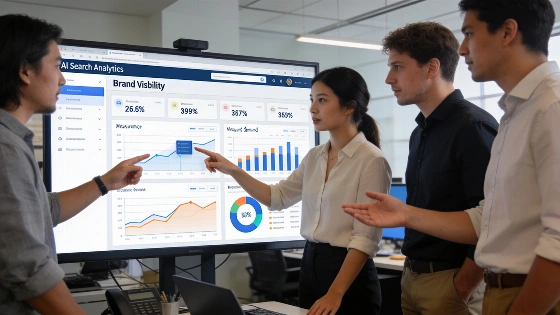
Over the past several months, six major organizations have released new research and frameworks for evaluating marketing performance in the era of AI-driven search. Their approaches span SEO, PR, analyst relations, and media measurement, but all point to a fundamental shift: website traffic alone no longer defines marketing success.
Instead of competing, these perspectives highlight different facets of the same measurement challenge. Examining them together reveals where their insights overlap, diverge, and what marketers can apply as they adapt to a zero-click, AI-powered landscape.
Zero-Click Reality
Rand Fishkin’s SparkToro analysis found that in early 2026, 68.01% of Google searches ended without a click, up from 60.45% in 2024. Fishkin attributes this rise to AI Overviews, now present in over 20% of searches and reducing click-through rates by nearly 60% when they appear. His recommendations include tracking brand and demand signals over time, conducting audience research to find where ideal customers pay attention, investing in off-site channels, continuing on-site content to influence AI Overviews, building short-form storytelling skills, and focusing SEO on branded, local, and high-intent searches.
SparkToro’s findings emphasize the importance of understanding where audience attention has shifted, especially as traditional traffic metrics lose relevance.
AI Visibility Tactics
Research from Fractl and Search Engine Land, presented by Kelsey Libert at SMX Advanced, revealed a sharp drop in consumer trust in AI search: from 82% in 2025 to 54% in 2026. Libert’s GEO tactic hierarchy divides strategies into high risk (FAQ optimization), table stakes (brand mentions, topical authority, structured data), and the moat (original data, proprietary research, digital PR). Their data shows branded web mentions and YouTube impressions correlate strongly with AI visibility, while backlinks and ad spend have weaker links. Buyers now check an average of 2.4 platforms before making a purchase, highlighting the need to measure influence, not just traffic.
This tactical approach signals a move away from link building and paid tactics, favoring earned placements and original research to boost AI visibility.
Upstream Evidence and Measurement
AMEC, the organization behind the Barcelona Principles, introduced seven GEO Principles and a Practitioner’s Guide to GEO Measurement in May 2026. Their model divides measurement into upstream reputation (earned, shared, and owned content), search and content readiness, and downstream AI output tracking. AMEC stresses that visibility in AI Overviews is just an output; true outcomes connect AI discovery to awareness, trust, behavior, and business impact. The guide recommends using a governed query library, documented prompts, repeat testing, and saved outputs as evidence, accepting that no single tool can directly link AI visibility to pipeline results.
For marketers, this means adopting a minimum evidence standard and triangulating data, rather than relying on a single dashboard metric.
Credibility and Trust in AI
Burson, a global PR agency, released "The Credibility Paradox: Advancing Generative Engine Optimization from Visibility to Reputation" in June. Partnering with Profound, Burson ran thousands of reputation-related prompts across seven AI platforms, generating over 55,000 believability forecasts. Their key finding: being cited by AI does not guarantee audience trust. Observable evidence-such as innovation, creativity, workplace, and products-outperformed self-described levers like leadership and governance by a two-to-one margin. Burson’s research suggests that credibility, while difficult to measure, can be proxied by behaviors such as following, sharing, or clicking, and should be prioritized in content strategies.
Analyst Influence and Source Credibility
Jamin Spitzer, a measurement consultant and former Microsoft insights leader, argues that GEO should be managed by analyst relations teams, especially in B2B. AI-generated answers to category leadership or vendor shortlists often synthesize analyst content from sources like Gartner and Forrester. Spitzer notes that GEO tools now make it possible to observe which analysts’ framing is reproduced, whether brand positioning is current, and where gaps exist between priority analysts and AI citations. This perspective highlights the unique influence of analyst content in shaping B2B buyer decisions-an angle often missed by consumer-focused measurement models.
Angela Dwyer at Full Intel adds another layer, analyzing which news sources AI platforms cite most often. Her research found a gap between citation frequency and audience trust, meaning a publication can be heavily cited by AI while its readers rate it as less trustworthy than competitors. This complicates the assumption that being cited by major outlets automatically transfers credibility.
For a deeper look at how AI-generated answers can disrupt paid search campaigns and shift brand recommendations, see this analysis of how AI Overviews impact paid ads on Google SERPs.
Combining Perspectives
Together, these six perspectives resemble different hands on the same elephant: SparkToro focuses on attention and correlation, Fractl on entity authority and earned mentions, AMEC on upstream evidence, Burson on credibility, Spitzer on analyst influence, and Dwyer on the trustworthiness of AI-cited sources. None replaces the others; each measures a distinct dimension of how AI shapes discovery, trust, and buying decisions. Marketers may need to blend these approaches to fully understand and influence demand in an AI-driven world.