
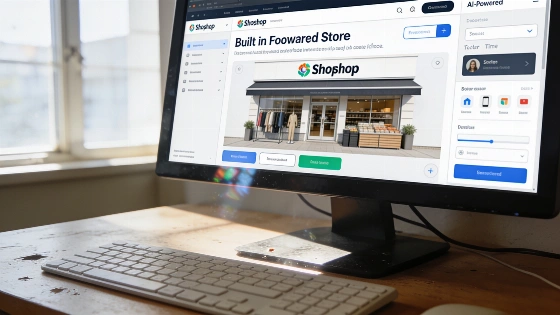
Merchants can build online storefronts on Shopify by describing what they want to an AI. Its new tool, Canvas, brings shops to life in real time, while an integration with Meta’s Muse could help merchants reach new customers.
Shopify is betting that AI will help small brands grow faster. Many of these merchants don’t have coders or designers. Canvas works with Shopify’s AI agent, Sidekick: merchants give instructions, and Sidekick makes instant changes to the store. No coding or design skills are needed; the store takes shape around the merchant’s vision.
Shopify has also teamed up with Meta Platforms to bring Meta’s Muse agent into the picture. Shop Pay is now built into Muse. Announced in September, the deal lets buyers check out on any Shopify store through Muse, potentially bringing new customers to Shopify merchants. Two days after the partnership went public, Shop Pay appeared as a wallet in Muse. The rollout was fast. A Forbes market report covered the details.
Shopify President Harley Finkelstein told investors that AI is already making a difference, especially for smaller merchants, who make up most of the company’s customer base. He pointed to a spike in AI-driven orders outside the top 100 product categories. In the second quarter, 75% of these orders came from niche segments. Finkelstein said traditional search engines rank products by keywords, while AI agents like Sidekick and Muse use structured data to match products with what buyers want. For example, they can find a car seat that fits three across a sedan, rather than returning any car seat.
Shopify’s Q3 numbers support that claim: sales jumped 34%, while gross merchandise volume rose 32%, reaching $115.57 billion in the second quarter. FactSet said Wall Street expected about 27% sales growth, a forecast Shopify exceeded. The company expects growth to stay in the low thirties for the third quarter. AI is driving measurable results.
Ben Sehl, Shopify’s director of product and co-founder of Kotn, says Canvas can let someone build a custom store in just twenty minutes. The AI understands detailed instructions, lowering the barrier for new merchants and speeding up launches. Other platforms, including Wix, also offer site builders. Shopify’s edge is its combination of backend creation and AI-powered traffic, a closed loop for commerce.
For content creators and digital sellers, the impact is immediate. Agentic AI now shapes how stores are built and how customers find them. Merchants who can clearly tell an AI what they want will launch faster and reach more targeted buyers. Those who stick to old search methods and manual setup may fall behind. As AI agents improve at matching products to buyer intent, the advantage goes to merchants who use these tools.
Shopify’s strategy fits a broader tech trend, as companies race to put AI into every part of their business. Meta’s buyout of Stilla.ai, as reported earlier, shows the fight to control agentic traffic and automated sales is heating up. The test for Shopify is whether Canvas and its AI partners can sustain merchant growth and smooth operations at scale, or whether fast, AI-powered site building remains a perk for early adopters.
Shopify’s double-digit sales and merchandise growth beat Wall Street expectations, giving its AI push a measurable result. With Canvas and Meta Muse live, Shopify is building the next layer of ecommerce. For digital operators, adapting to AI-driven workflows may be impressive to avoid falling behind.








