Retail Media’s infrastructure is ready, but advertisers now want proof of impact. Industry leaders say the next phase requires better data, smarter campaigns, and clear evidence for non-endemic brands.
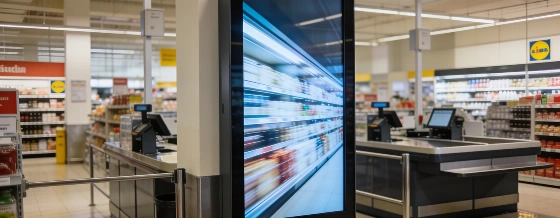
Retail Media in Germany has reached a technical milestone: about 95% of in-store screens can now be booked programmatically through the SSP1 platform from One Tech Group. Yet, as the infrastructure matures, industry leaders say the real challenge is just beginning. Daniel Siegmund of One Tech Group and David von Hilchen of StackAdapt told MEEDIA that future growth depends on delivering measurable results, richer data, and more sophisticated campaign strategies-especially for non-endemic advertisers.
While the sector continues to post double-digit growth, Siegmund noted that some retailers underestimated the complexity of digital monetization. He pointed to the need for robust audience modeling, reliable measurement of ad effectiveness, and managing a diverse range of screens. Von Hilchen, who leads StackAdapt’s DACH sales, added that consolidation pressures are typical as markets mature, but the pace of growth remains strong overall.
Siegmund emphasized that, technically, launching a campaign has never been easier. However, he said the real work starts after setup: explaining different touchpoints, integrating data, and proving campaign impact. He argued that the market now needs to fill its infrastructure with actionable insights and content to unlock its full potential.
To address ongoing knowledge gaps, Siegmund described how One Tech Group shares best practices with partners and advances knowledge transfer through industry bodies like BVDW. He highlighted emerging channels such as Instore Audio and the rapid adoption of AI applications, noting that expectations have shifted from initial excitement to the need for credible proof-especially to attract non-endemic budgets.
Von Hilchen agreed that campaign success increasingly depends on individualization, but said that AI chatbots alone are not enough. He explained that only when all key functions-first-party data targeting, measurement, and dynamic creative optimization-are natively integrated can AI models optimize campaigns in real time. He cited a recent omnichannel campaign for OMODA JAECOO, where StackAdapt’s chatbot Ivy translated complex strategies into campaign setups within minutes, enabling granular targeting by location and context.
Asked whether programmatic in Retail Media will follow the path of display advertising, von Hilchen said the answer depends on the buying model-whether programmatic guaranteed, private marketplaces, or open auctions. Siegmund observed that as demand grows, auctions will become more important, and retailers will need to refine their monetization strategies to maximize limited screen attention.
On pricing, Siegmund reported that the market is seeing more flexible and differentiated pricing models, driven by smarter processes and increased intelligence. He said this evolution is a sign of market maturity, not a general price decline.
Both executives discussed the role of AI in agency workflows. Von Hilchen noted that agencies are developing their own AI solutions, combining performance and customer data to create value. He described scenarios where agency-side AI agents could communicate directly with platforms like StackAdapt to automate media planning and campaign execution. Siegmund added that AI now enables rapid, intelligent analysis of diverse data sources, making budget allocation more objective and efficient than before.
Addressing concerns about the dominance of major platforms, Siegmund argued that large players like Meta do not always deliver the best performance, despite strong sales efforts. Von Hilchen said that what matters most is not CPM, but whether the desired effect can be measured-such as increased usage of a payment service or higher sales at the point of sale. He believes advertisers will pay more for placements with proven impact, especially at checkout screens, where attention is highest.
Von Hilchen also addressed the competitive landscape among demand-side platforms (DSPs), noting that while some platforms can offer low fees due to their broader business models, there remains a clear market for independent, transparent omnichannel DSPs. He said StackAdapt is now the world’s second-largest independent DSP and the fastest-growing, attributing this to its product architecture and use of AI.
As the sector looks ahead to DMEXCO, Siegmund urged advertisers to recognize the untapped potential of in-store audiences, where 80% of consumers and spending occur, but only a small share of ad budgets is allocated. He called for a joint effort among advertisers, technology providers, and retailers to deliver the proof needed to justify shifting more budgets to Retail Media. Von Hilchen agreed, stressing the need for robust evidence of impact for non-endemic brands and encouraging advertisers to test campaigns at scale to generate statistically meaningful results.
For further insight into how AI is reshaping advertising and monetization strategies, see this analysis of identity-less ad environments and new revenue streams: how publishers are adapting to signal loss in digital advertising.