Installing clean Rank Math PRO 3.0.124 does not remove malicious files or administrator accounts already planted elsewhere on a server. The malware can also recreate its hidden backdoor whenever someone visits an infected site, Rank Math said in an October 16 security notice.
Some copies downloaded from rankmath.com or delivered as updates between 20:02 UTC on October 15 and 07:12 UTC on October 16 contained malware. The potential exposure window lasted 11 hours and 10 minutes; the incident did not affect every copy of version 3.0.123. Rank Math removed the affected files and released version 3.0.124. Wordfence warned in an October 17 advisory that replacing the plugin leaves other malware changes untouched.
Who is affected
The version number alone does not establish whether a copy was compromised. Rank Math’s changelog dates 3.0.123 to October 7, before the incident window opened. A copy obtained before 20:02 UTC on October 15 falls outside the window; the notice concerns copies downloaded or installed through an update during that period.
Rank Math’s notice gives three cases. Anyone who installed and activated 3.0.123 during the window should treat the site as compromised, even if it has since been updated to 3.0.124, and follow the recovery steps. If the plugin was installed but never activated, delete its files, install 3.0.124 from a Rank Math account, and run a security scan. A download that was never installed or activated does not by itself indicate a compromised site.
The notice applies to the paid PRO plugin, distributed through rankmath.com. It does not name the free Rank Math SEO plugin on WordPress.org, which has more than 4 million active installations and was last updated October 6. Rank Math has emailed some users and advises anyone uncertain whether the files were installed or activated to contact support.
What to check
Rank Math and Wordfence have not published code analysis or identified who is behind the attack. Rank Math says the malware can restore its backdoor on a site visit, so deleting suspicious files before stopping that mechanism may leave the site exposed. Wordfence assigned the incident CVE-2026-111862, rated it 9.8 out of 10, and listed the researcher as unknown. Patchstack classifies it as a backdoor and says “a rule is not possible for mitigation.”
The attacker may have placed PHP backdoors in other plugins’ folders, theme folders, the must-use plugins directory, or uploads. Other reported changes include administrator accounts, a fake WordPress core file, and .htaccess rules that let .cache files run as PHP. The malware may also have added scheduled tasks or SSH keys. The SecurityWeek report, citing Rank Math and Wordfence, says the malware could provide persistent access and expose credentials, API keys, and other secrets available to the web server. Any password, database credential, API key, or other secret the site could reach should be treated as exposed.
Wordfence’s checks include PHP using base64_decode with XOR loops, the key xmmqhn, proc_open, or PHP-FPM socket code. Look for wp-includes/class-wp-cache-util.php, which is not a WordPress core file; administrator usernames beginning wpsupport_; and accounts with addresses ending @wp-mail[.]net. Server checks cover .cache files containing PHP, #ms6v46 entries in the web server user’s crontab, WordPress scheduled events, SSH authorized_keys files, other users’ crontabs, running processes, and writable locations outside the site. Wordfence cautions: “Their absence does not, by itself, prove that a website is clean.”
Recovery order
Rank Math prefers restoring a site and its database from a backup made before 20:02 UTC on October 15. After restoring, run a security scan, change every password and credential, and only then install 3.0.124 from a Rank Math account.
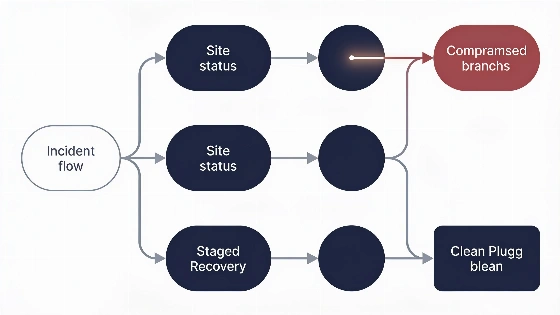
Without a clean backup, the notice puts three actions first. Delete the entire rank-math-pro folder through the hosting file manager or FTP; “Deactivating the plugin alone is not sufficient.” Next, remove any wp_options entries whose option_name is _uf6qdn2hmm, t8krdk990phb, or _np5pvf754c. Then block outgoing connections to rank1cdn[.]com if the host or firewall permits it.
Change WordPress passwords and the database username and password in wp-config.php. Rotate its security keys and salts, payment gateway credentials, SMTP and other API keys, hosting control panel access, FTP, SFTP and SSH access, environment-variable secrets, and administrator two-factor authentication. Finish with a security scan, wp core verify-checksums, and wp plugin verify-checksums --all. Checksums may not exist for premium plugins: WordPress.org publishes none for Rank Math PRO. The Hacker News checked its plugin-checksums service on October 19 and found no PRO file under either name, though the service has one for the free plugin.
What remains unknown
Download the clean 3.0.124 directly after logging in at rankmath.com. Some customers may need to reset their account password to log in; Rank Math’s notice does not explain why. The company says it will never send login or download links by email.
Rank Math, part of Swedish hosting group group.one, has not said how the malicious files entered its download and update system, how many customers received them, whether automatic updates delivered them, or provided hashes for the clean and tainted packages. It says the team is taking steps to reduce the risk of similar incidents. Registry records show rank1cdn[.]com was registered at 19:31 UTC on October 14, about a day before the incident window began.
This is at least the third premium WordPress plugin vendor update-channel incident this year. Nextend’s system served a backdoored Smart Slider 3 Pro for about six hours in April. In June, ShapedPlugin’s Pro plugins were found backdoored in its update channel; one package that had shipped clean was later “tampered with under the same version number.” Attackers also altered scripts served from Awesome Motive’s CDN in June and poisoned BdThemes’ API feed in August. Nothing published links those attackers to the Rank Math incident.