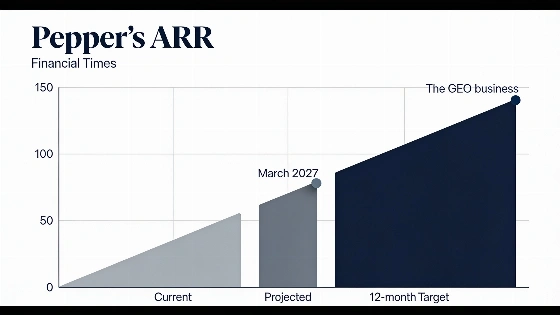
Pepper’s enterprise contracts show the shift: more than 40 clients pay over $100,000 a year for its work. More than 10 pay over $200,000, while three pay over $400,000. The company says it works with more than 250 enterprises globally and has crossed $11 million in ARR. Its target is $30 million over the next 12 months, about 2.7 times its reported ARR.
Pepper has publicly discussed work with Amazon, Instacart, General Mills, Unilever, Mutual of Omaha, Coca-Cola, Basic Garden and Pet and PepsiCo.
Selling visibility
Pepper has moved beyond content production, selling services aimed at helping businesses get discovered. It says it has grown by over 300% in the last 18 months as its SEO and generative engine improvement business expanded. Co-founder Anirudh Singla says that business barely existed 18 months ago and is expected to cross $10 million ARR shortly.
Generative AI forced the company to confront whether customers would keep paying for words a model could produce in seconds. “If your business is simply producing words, AI is going to have a huge impact on it. There is no point pretending otherwise,” Singla said. He said customers wanted to be discovered and build authority, rather than simply buy written material.
Pepper now works on SEO and organic growth, with GEO focused on how brands appear in answers from ChatGPT, Gemini, Perplexity and Google AI Overviews. Google’s guidance for AI features says pages must be indexed and eligible to appear with a search snippet, and that there are no additional technical requirements for inclusion. It also emphasizes established SEO fundamentals such as crawlability, useful original content and clear page organization, rather than special AI files or markup. Singla called the shift “probably the biggest reason for our growth.” Client requests have moved from orders for 100 articles to questions about visibility in search and AI answers.
Larger contracts
Singla says large companies want delivery, not another software dashboard. “Large companies don't need another dashboard telling them they have a problem. Most of them already have too many dashboards. They want outcomes.”
Pepper’s model operates at a different scale from the smaller search-led example in FAYFO’s Voltaire coverage, which described daily SEO guides supporting an app whose $399.99 lifetime plan supplied over 80% of revenue.
How Atlas works
The US accounts for around 80% of Pepper’s current growth. The company says customer budgets are coming from SEO, content, organic growth and demand generation, with some money coming from new AI allocations. “Six months ago, it was, ‘How often does my company appear on ChatGPT?’ Now it is, ‘Why is my competitor appearing instead of me, and what can I do about it?’ That is when a category starts becoming real,” Singla said.
Pepper’s Atlas platform began as an internal tool. The company says it has run more than 10 million prompt checks through the system to identify patterns affecting AI visibility. Agent Atlas combines GEO data with Search Console, analytics and CMS information, then helps teams prioritize and carry out changes.
Singla says competitors can access the underlying models. “We don't have access to an AI model nobody else has. Everyone can use OpenAI, Anthropic or Google,” he said. “The difference is what you build around those models and what you learn from running programmes at scale.”
Profit and targets
Pepper says it is already profitable. It expects revenue of about Rs 120 crore and EBITDA of around Rs 20 crore this financial year, a margin of roughly 16% to 17%. The company plans to exit March 2027 at an annualized run rate of about $16 million, then pursue its $30 million ARR target over the following 12 months.