
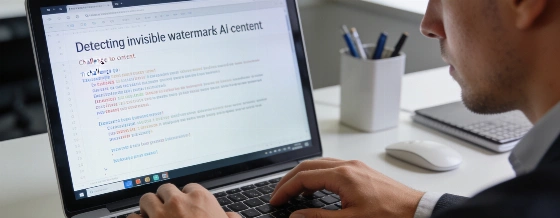
AI-generated text now often carries hidden watermarks that reveal its origin. These statistical markers, used by platforms like Claude, are nearly impossible to erase without advanced tools. Find out how they work and why they matter.
AI-generated content is increasingly marked by invisible watermarks-statistical patterns embedded in the text that signal its artificial origin. Unlike visible tags or hidden metadata, these watermarks subtly alter word choices during generation, making detection possible for those with the right tools. The Claude model, developed by Anthropic, uses a watermarking approach similar to SynthID-Text, which Google integrated into Gemini in 2024.
These watermarks are not detectable or removable by standard tools. Without access to the specific API or key, platforms like Google, Originality, or GPTZero cannot identify or erase Claude's watermarks. This limitation means that claims of universal watermark removal are unfounded when it comes to Claude-generated content.
Anthropic has acknowledged several limitations of its watermarking system. Watermarks are less effective in short texts and in content dense with factual information. Code generated by Claude typically contains fewer watermarks, and if a human edits the text using Claude, the watermarking almost disappears. Completely rewriting the text-replacing every word-removes the watermark entirely. However, translations performed by Claude still retain the watermark signature.
In practice, the reliability of watermark detection depends on the cost and effort required to remove them. Paraphrasing the content with a different AI model is often an effective way to bypass these markers. This raises questions about the long-term effectiveness of watermarking as a method for tracking AI-generated content, especially as tools and techniques evolve.
For those monitoring the integrity of AI-generated outputs, the challenge is not just in detection but in verification. As highlighted in a related analysis, the need for proof that AI-built tools actually function as claimed is becoming more urgent for agencies and brands. For more on the importance of verifying AI-generated results, see this recent discussion on the necessity of validation in AI tools.
Anthropic, the company behind Claude, was founded in 2021 and has rapidly become a major player in the AI space. By 2026, Anthropic has raised over $7 billion in funding and is valued at more than $18 billion, with its Claude model widely adopted by enterprises seeking advanced, trustworthy AI solutions. The company's focus on safety and transparency has positioned it as a leader in responsible AI development.