
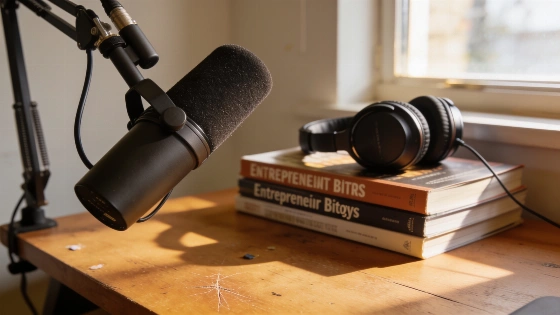
David Senra’s Founders podcast generates millions of dollars in annual profit despite having no full-time staff. He has rejected acquisition offers, including one valued at over $50 million, to retain control. In an interview with Fortune, Senra said he built the show on the belief that outside funding often comes with strings attached. He insisted on running it as he saw fit, even if that meant slower progress.
Launched in 2016, Founders spent its first five and a half years with little audience. Each week, Senra read a printed biography of an entrepreneur, highlighted basic insights, then recorded a solo episode based on the book. Early episodes featured figures such as Elon Musk and Walt Disney, as well as Thomas Edison, Joseph Kennedy and Steve Jobs. Senra handles the basic work himself: he researches and prepares each episode, then records it, with the books providing its foundation. He was prepared to continue even if an audience never materialized.
Eventually, a small but highly influential group of listeners emerged. Today, Founders is followed by Jeff Bezos, Shopify CEO Tobi Lütke, Coinbase CEO Brian Armstrong, Michael Dell and Spotify CEO Daniel Ek, among others. Serial entrepreneur Brad Jacobs credited one episode with helping him raise $750 million from listeners, showing how the show’s reach extends beyond advertising into founder and investor networks.
The show has no full-time staff and relies on two contractors to handle short-form clips and cover art. Senra has rejected acquisition offers to maintain control over the show’s quality and direction, keeping its operation lean while retaining editorial authority.
Founders’ advertising model is built on long-term partnerships with companies Senra personally uses. Its largest sponsor is fintech company Ramp, valued at $44 billion in the article’s account, which approached Senra directly to collaborate. He did not have to pitch the company on advertising. Ramp provides expense-management tools for businesses; in a podcast advertisement, the company claimed its median customer cuts expenses by 5%.
Senra’s approach also influenced TBPN, a daily technology talk show that has also operated a marketing and communications advisory business. He supported TBPN early, recommending it to Ramp and helping it gain visibility. In early 2024, OpenAI acquired the rapidly growing company for hundreds of millions of dollars. Senra received no share or commission from the deal, but got 50 partnership offers on the day of the acquisition. TBPN President Dylan Abruscato described OpenAI’s interest as “much more about the interest in kind of us and the kind of brains behind the operation,” calling it “a marketing and comms play more so than a distribution play.”
OpenAI framed the arrangement around its communications needs. Fidji Simo, then the company’s CEO of AGI Deployment, said, “The standard communications playbook just doesn’t apply to us.” Abruscato said TBPN’s programming and guest selection would remain under its control and that the company would continue operating independently. He also said, “By no means was OpenAI trying to get into the podcast world. I can’t speak to anyone else, but this was just a unique situation.” Senra has said he prefers to earn from products he creates instead of betting on other companies.
Senra says the Founders story shows the value of persistence and of building for the right audience, whether or not it is large. For media operators, it shows how slow growth and independence can underpin a highly profitable business when quality remains basic.
As of 2026, Founders’ largest sponsor, Ramp, was valued at $44 billion, reflecting the caliber of partners the podcast attracts.








