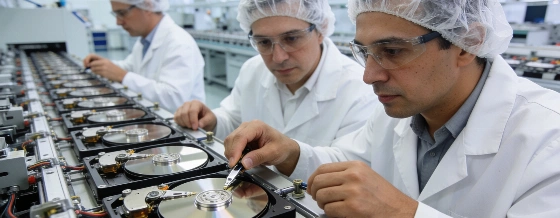
Major HDD manufacturers are expanding production capacity, signaling a shift toward higher unit shipments by 2030. New investments in head manufacturing could drive growth beyond current forecasts, fueled by AI data needs.
Hard disk drive (HDD) makers are ramping up production capacity in response to growing demand from artificial intelligence workloads, with industry analysts now projecting a notable increase in unit shipments by the end of the decade. While Seagate and Western Digital have recently emphasized total storage capacity shipped over the number of drives sold, new manufacturing investments suggest a shift toward higher unit output as well.
Coughlin Associates, a storage market research firm, estimates HDD unit shipments will rise by 1.2% from 2025 to 2026, following a modest 0.4% increase from 2024 to 2025. Their median projection points to an 11% growth in unit shipments between 2026 and 2030. However, recent announcements from key component suppliers indicate the potential for even stronger growth-possibly up to 30% over the same period, according to the firm's high-end scenario.
Seagate is making a major investment in its Minnesota-based HDD head manufacturing facility, nearly tripling its clean room space from 11,000 to 19,000 square feet. This expansion, expected to be operational by late 2027 or 2028, is likely focused on producing advanced heat-assisted magnetic recording (HAMR) heads, a critical technology for next-generation drives. Magnetic heads, produced using semiconductor-like processes, are a key bottleneck in scaling HDD production.
In recent investor discussions, Seagate has reiterated its commitment to increasing HAMR HDD output to meet capacity shipment targets, rather than simply boosting unit volume. Western Digital, meanwhile, has increased the number of disks and heads per drive-now up to 11, with plans for 14-while also prioritizing total capacity shipped. Despite this, Seagate's manufacturing expansion signals a readiness to increase unit production when the new facilities come online, likely resulting in additional output by 2027 or 2028.
TDK, a major supplier of HDD heads for Toshiba and occasionally for Seagate and Western Digital, also announced plans to expand its head production capacity in April. While Western Digital has not publicly disclosed similar investments, industry observers expect the company to follow suit to support both higher component-count drives and rising demand for high-capacity HDDs.
These manufacturing moves point to a broader industry trend: by the end of the decade, HDD makers may be shipping more drives-not just more terabytes-to meet the surging storage needs of AI and data-intensive applications.
According to Forbes, Seagate Technology was founded in 1979 and is headquartered in Fremont, California. As of 2025, the company employs over 40,000 people worldwide and reported annual revenues exceeding $7.5 billion. Seagate is recognized as one of the largest HDD manufacturers globally, with a significant share of the enterprise and cloud storage markets.