Chains with strong local digital presence are opening new locations while rivals with weak AI and search visibility are shutting doors. SOCi’s latest data reveals a 14.8-point gap in digital performance that predicts real-world expansion or contraction.
Restaurant chains are no longer just competing over menus or locations. The real contest is happening online, where AI platforms and search engines quietly shape which brands grow and which ones fall behind. SOCi’s 2026 Local Visibility Index draws a clear line: chains that are expanding dominate AI recommendations and local search, while those shrinking barely register.
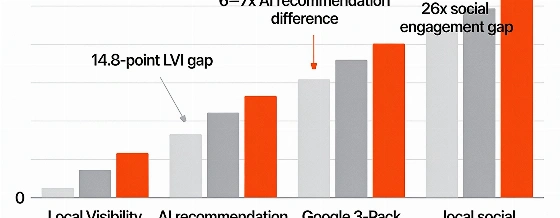
Economic cycles and private equity are no longer the main story. SOCi’s data compared eight restaurant brands that are opening new locations to eight that are closing stores. The difference is measurable: expanding brands scored 61.4 on the Local Visibility Index, while contracting brands managed only 46.6-a 14.8-point gap. This divide shows up everywhere: search rankings, review scores, social engagement, and especially in AI-driven recommendations.
SOCi's research found that ChatGPT recommends only 1.2% of all local business locations, and a staggering 83% of restaurant locations never appear in AI recommendations at all.
SOCi
The AI filter
AI is now a gatekeeper for local discovery. Expanding chains are recommended by ChatGPT in 20% of tested queries, while shrinking brands show up in just 3%. Gemini and Perplexity follow the same pattern, with expanding brands earning higher AI-assigned star ratings. Only 1-11% of all brand locations are recommended by these AI platforms, compared to 35.9% that appear in Google’s 3-Pack. Getting noticed by AI now requires accurate data, a strong reputation, and unique content, as detailed in the SOCi 2026 Local Visibility Index analysis.
These results echo earlier reports about AI’s growing influence in search and brand discovery. The difference now is that AI’s selectivity is directly shaping which chains get foot traffic and which are left out.
Search and reputation metrics
The AI gap is built on fundamentals. Expanding chains appear in Google’s 3-Pack for 35.3% of tracked searches, compared to just 14.4% for contracting brands. On Yelp, expanding brands take the top organic spot 55% of the time, while shrinking brands do so only 29.3% of the time. Reputation scores are just as lopsided: expanding brands average a 4.39 Google rating and 3.65 on Yelp, while contracting brands lag at 3.82 and 2.49. The difference isn’t just in the numbers-expanding brands respond to 72.4% of Google reviews, often two to three times faster than their shrinking competitors, who only manage 43.6%.
SOCi evaluated over 350,000 locations from 2,751 multi-location brands and found that AI platforms are far more selective than traditional search. While 35.9% of locations appear in Google’s 3-Pack, only 1-11% are recommended by AI platforms like ChatGPT, Gemini, and Perplexity. This selectivity is driven by a combination of data accuracy, reputation, reviews, social engagement, and unique content.
MarTech, Industry Analysis
Review response rates aren’t just a passive metric. They’re a lever that marketing teams can pull right away. The data shows that brands on the rise treat local reputation as a core discipline, not a box to check.
Social engagement and local content
The gap is even wider on social media. Expanding brands see a 3.45% local social engagement rate, compared to just 0.13% for contracting brands-a 26-fold difference. Local follower counts are five times higher for the winners. But it’s not about posting more often; it’s about posting content tailored to each market. Expanding brands avoid the generic approach of sending the same message everywhere. SOCi’s research confirms that localized content is what actually drives engagement.
For marketers, the lesson is straightforward: digital visibility isn’t a set of disconnected tasks. Brands that are growing treat data accuracy, review response, social engagement, and AI visibility as one system. Keeping business data up to date, responding to reviews, and localizing social content are now the basics. If you haven’t checked your brand’s presence in ChatGPT, Gemini, and Perplexity, you’re missing what matters in today’s AI-driven marketplace.
Chains that ignore these fundamentals aren’t just losing digital traffic-they’re losing real-world growth. The evidence is clear: digital visibility now predicts which restaurant brands will open new doors and which will close them. The winners aren’t waiting for the industry to catch up. They’re already building the next wave of local dominance, one AI recommendation at a time.
SOCi, founded in 2012, provides local marketing and visibility analytics for multi-location brands. The company serves over 700 enterprise clients across the United States, including major restaurant, retail, and service chains. SOCi’s Local Visibility Index is now widely used as a benchmarking tool for digital performance, and its platform processes millions of data points monthly from Google, Yelp, Facebook, and emerging AI platforms. In 2025, SOCi reported annual recurring revenue exceeding $60 million, reflecting the growing demand for digital visibility insights as AI-driven discovery overtakes traditional search.