
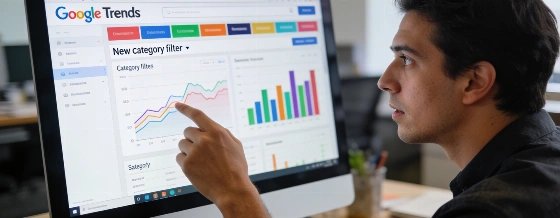
Writers and publishers can now browse trending topics by category on Google Trends without entering a search term. The new feature promises sharper insights and more relevant data for content planning.
Writers looking for story ideas no longer have to guess what’s trending in their field. Google Trends has introduced a feature that lets users filter the Explore page by category, without needing to enter a search term. Now, you can see the most-searched topics in any sector-from "All Books & Literature" to dozens of other areas-giving content creators a direct look at what people are searching for right now.
Search Engine Land and Search Engine Roundtable both confirmed that the new category filters in Google Trends work with or without a search query, allowing users to see top queries in any category instantly.
Using a category filter without a search term shows the top-searched topics in that field, broken down by region and time period. This is useful for publishers, marketers, and SEO professionals who want to spot rising topics before others do. It also helps cut out unrelated results when researching a niche. Google’s advice: "Apply the category filter without entering a query to explore category-specific top-searched terms across specific categories, regions, and timeframes."
The new category filters represent a logical evolution of Google Trends: previously, users had to start with a specific search term, but now they can select a category first and then explore surges of interest within it. This shift is especially useful for niche analysis and reduces irrelevant data noise, as highlighted by industry experts.
The new filters arrive as publishers face more pressure to deliver relevant, high-performing content at scale. This update follows other recent changes to Google’s data and reporting tools, including a shift in AdSense impression counting reported earlier. Each change reflects Google’s effort to give creators more control over analytics and monetization.
According to Search Engine Land, the main benefit of these filters is a big drop in irrelevant results, making it easier for publishers and marketers to focus on trends that matter to their specific fields. This is especially important for SEO specialists who need to avoid overlap with unrelated queries.
In practice, the filters are simple: pick a category, and Google Trends shows the top search terms in that space. No login or setup needed-just instant access to what’s trending. The update is especially helpful for teams managing several verticals or targeting different audiences, since it highlights only the most relevant data.
As Search Engine Roundtable reports, the update has already drawn industry attention. Experts note that being able to filter by category, with or without a search term, is a real improvement for anyone tracking trends or planning content.
This change signals a shift in how digital publishers and marketers come up with ideas. Relying only on gut instinct is less practical now. With Google Trends’ category filters, those who can read and act on real-time data have an edge. The feature doesn’t replace creativity, but it does show which ideas are getting attention. For anyone focused on audience growth or SEO, this tool is now hard to ignore.
Google Trends, launched in 2006, is used by millions of journalists, marketers, and researchers to track search behavior. The platform’s data updates in near real-time and covers hundreds of categories, making it a standard tool for trend analysis in digital publishing. Google’s parent company, Alphabet, reported over $300 billion in annual revenue in 2025, much of it from search and advertising products that depend on accurate, timely data.