
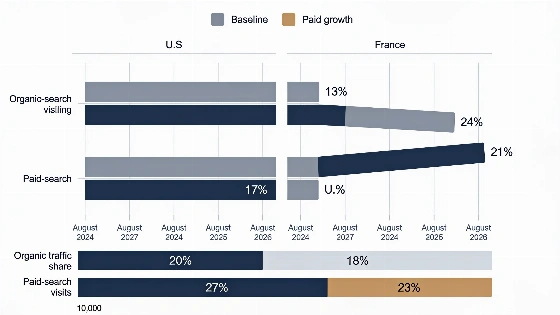
Similarweb's dataset covers monthly traffic estimates for 10,000 domains in the United States and France. Its broader series runs from September 2023 through August 2026, with the basic comparison covering August 2024 to August 2026. Over those two years, organic-search visits fell from 19.9 billion to 17.3 billion in the U.S., a 13.2% decline, and from 4.0 billion to 3.0 billion in France, a 24.4% decline. Paid-search visits rose 21% in the U.S. and 17.3% in France, information from Kevin Indig’s Growth Memo analysis.
The shift also shows up in traffic mix. Organic search's share of total traffic dropped from 20% to 18% in the U.S. and from 27% to 23% in France. Indig estimated that paid-search growth equaled about 36.6% of the lost organic volume in the U.S. and 6.7% in France.
The figures come from research by Kevin Indig, who argues that Google's growing ad load and more aggressive algorithm updates are costing publishers clicks. Search ads take up more space and can be harder to distinguish from organic results, he says. Paid and organic search are separate channels; advertisers pay for placements, while organic results are ranked without payment. Their opposing trends do not mean every lost organic visit shifted to an ad. Indig’s basic point is that the decline is “not all AI.”
France offers a useful comparison. Google launched AI Overviews and AI Mode there on July 22, 2026, near the end of the period measured, after a delay linked to press neighboring-rights disputes. French coverage reported the launch alongside an announcement by Sébastien Missoffe, managing director of Google France. AI Overviews place a Gemini-generated summary above conventional search links. The timing cautions against attributing the full two-year decline to those Google features, although chatbots and other AI services also influenced user behavior in France. Journal du Net reported that the products had arrived in several other European markets earlier, including from March 2025.
Publisher data points to other possible drivers of search losses; a separate publisher case study tracked declines that coincided with an AI-assisted content test. Indig's analysis points to a different pressure in broader search results: paid-search traffic increased in both markets as organic visits fell.
A separate review of Indig’s referral-traffic investigation examined 12 Google Analytics 4 properties, primarily U.S.-oriented and skewed toward business-to-business sites. The review excluded homepages and pricing pages, along with login pages, and counted 2,825,594 organic-search sessions and 72,095 AI-referral sessions. That works out to about one AI-referral session for every 39 organic-search sessions. In the same reviewed sample, direct traffic rose between January and September 2026, but bots substantially affected the increase; counting engaged visits, direct traffic was flat.








