

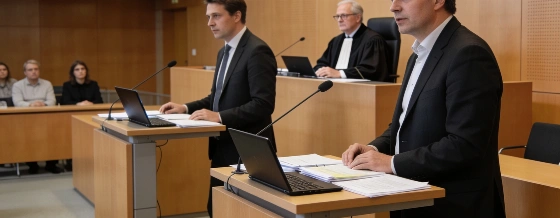
A Munich court found Suno liable for copyright infringement after it used GEMA-represented songs to train its AI music platform without a license. The decision extends EU legal risk to AI companies worldwide and forces Suno to disclose revenue tied to the infringed works.
On July 31, a Munich court delivered a landmark decision against Suno, the AI music platform, ruling that it infringed copyrights managed by GEMA, Germany’s music collecting society. The court found Suno had trained its models on well-known songs like "Rasputin" by Boney M. and "Forever Young" by Alphaville without permission, then reproduced them on demand for users. GEMA, which represents over 100,000 composers, lyricists, and publishers, initiated the lawsuit in January 2025 after Suno failed to respond to licensing requests. The case focused on six popular tracks, including "Atemlos" (Helene Fischer), "Daddy Cool" (Boney M.), "Big in Japan" (Alphaville), and "Mambo No. 5" (Lou Bega). GEMA’s legal team demonstrated that Suno could generate audio nearly identical to the originals simply by prompting the AI with lyrics, style, and title.
The court’s analysis centered on what it called "memorization"-evidence that Suno’s AI models stored and could reproduce near-complete copies of specific songs, rather than creating new works. However, the decisive factor was Suno’s own admission: the company conceded it had trained on GEMA’s repertoire without a license. Suno’s defense, that AI training does not require a license, was rejected outright. Judge Elke Schwager also noted that Suno obtained its training data through stream-ripping, downloading audio from the open web instead of licensed sources. This admission, combined with the court’s findings, left little room for Suno to avoid liability.
Perhaps the most far-reaching aspect of the ruling is its stance on jurisdiction. For the first time, a European court asserted that German law applies to AI training conducted entirely outside the EU if the outputs are served to users in Germany. Under Section 131 of the VGG, the court determined that Suno’s Massachusetts-based training runs fell under German jurisdiction because the resulting AI-generated music was accessible to German users. The court also stated that Suno would have owed GEMA a license even under U.S. copyright law. If upheld on appeal, this precedent exposes any AI company with EU users to potential litigation, regardless of where their models are built or trained.
In addition to the injunction, the court ordered Suno to disclose its revenue linked to the six infringing works. This means GEMA will gain access to Suno’s financial records to determine damages based on actual earnings from those songs. While Suno’s overall numbers are public-such as a $5.4 billion valuation and $300 million in annual recurring revenue from 2 million paid subscribers-the specific revenue tied to GEMA’s catalog has not been disclosed until now. For comparison, Universal and Sony’s ongoing U.S. lawsuits seek up to $150,000 per infringed work, with combined claims reportedly exceeding $9 billion. GEMA’s case, however, will be calculated based on actual revenue and license-fee equivalents under German law.
Industry Impact
This ruling gives GEMA a stronger position in licensing negotiations, especially compared to Warner Music, which settled its lawsuit with Suno in November 2025 without a court judgment or compelled financial disclosure. Warner’s deal included a licensing agreement and Suno’s acquisition of Warner’s Songkick platform, but did not require Suno to admit liability. Now, with a court-ordered disclosure and a finding of infringement, GEMA may secure higher per-stream or per-work fees than Warner, raising questions about whether Warner settled too soon. Other rights holders are likely to watch GEMA’s outcome closely before finalizing their own agreements with Suno.
The Munich decision also sets a precedent for other ongoing cases. Denmark’s collecting society Koda sued Suno in November 2025 over similar allegations involving Danish artists, and that case is still pending. In the U.S., Universal and Sony’s lawsuits remain active, seeking statutory damages that could reach billions. All these cases are expected to cite the Munich court’s reasoning on jurisdiction and admissions, making this ruling significant beyond the six songs at its core. The pattern is clear: AI companies often train first, license later-or never-and only reveal their financial exposure when forced by court order.
As AI-generated content continues to disrupt creative industries, the Suno-GEMA case highlights the legal and financial risks for platforms that use copyrighted material without proper licensing. The decision underscores the importance of transparency and compliance for any AI company operating in or serving users in the EU. For creators and rights holders, the ruling offers a new legal tool to challenge unlicensed use of their work, while for AI developers, it signals a need to rethink data sourcing and licensing strategies.
Recent legal battles over AI-generated content have also affected other creative sectors. For example, the surge of AI art and drop-shipping on platforms like Etsy has driven longtime creators to seek alternatives, as explored.
Founded in the United States, Suno has rapidly grown to a $5.4 billion valuation, fueled by a $400 million Series D round and a user base of 2 million paid subscribers generating approximately $300 million in annual recurring revenue. The company’s CEO, Mikey Shulman, has positioned Suno as a leader in AI-generated music, but the recent court ruling and ongoing legal challenges in Europe and the U.S. now threaten its business model and future growth prospects.