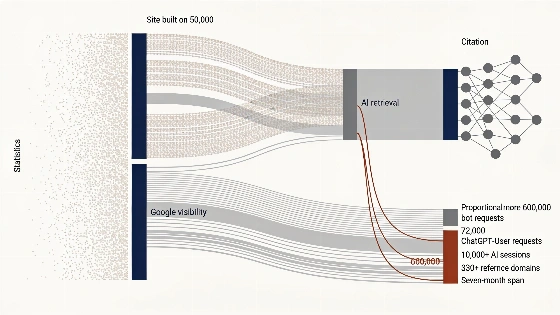
For seven months, StateGlobe remained in ChatGPT’s retrieval stream even as its Google visibility fell away. The site drew more than 10,000 sessions from ChatGPT and attracted 330+ referring domains; its fabricated figures also appeared in an academic paper and financial research.
The creator’s experiment suggests AI answers can expose unsupported numbers to other sources, which may then repeat them as fact.
The evidence trail
In one day, the site’s creator used GPT-4.1 to generate 50,000 statistics. The figures covered SEO and content marketing, as well as topics ranging from social media to web technology, including e-commerce. The material spanned 200 countries, and none of the numbers was checked. The creator later added 15,000 listicles. The total cost came to about $50: roughly $30 for the initial setup and $20 for the listicles.
Google indexed nearly the entire site within a week. Two updates followed soon after launch, and visibility collapsed. The pages have since been deindexed, with impressions fluctuating between 5 and 20. A subdomain test brought little improvement. Google Search Central’s spam policy guidance targets scaled content abuse designed to manipulate rankings, regardless of whether people or automated systems, including generative AI, produce the pages.
ChatGPT kept pulling pages. During the 30 days before the creator checked Cloudflare’s crawl data, StateGlobe received more than 600,000 bot requests. About 72,000 came from ChatGPT-User, the agent that opens pages in real time as ChatGPT answers questions. Those requests indicate page access during a user interaction; by themselves, they do not show that the pages were crawled for training. OpenAI distinguishes GPTBot, which gathers pages that may be used to improve models, from its search crawlers: OAI-SearchBot supports ChatGPT search, while ChatGPT-User opens pages in response to user requests. A site can allow OAI-SearchBot while blocking GPTBot, keeping pages available for search answers without permitting the separate training-related crawler.
How retrieval rewards stats
Search ranking and AI retrieval are separate challenges. ChatGPT can break a prompt into fanout queries, find candidate pages through search sources or its cache, then rerank them. It may open selected pages to ground an answer. A page buried in Google results can still surface during that process.
Statistics give models a specific detail to use when drafting researched content. Given limits on latency and cost, a system may score passages for relevance without independently checking every number. A figure that looks useful and comes from a page that appears authoritative can make it into an answer without being true.
Freshness cues may help. A date in a heading can make a statistics page look current; dates in titles and URLs can do the same. On October 7, the creator’s Peec dashboard ranked StateGlobe second for visibility on tracked prompts, behind Statista. The creator also reported more than 10,000 ChatGPT sessions since March. Google Analytics 4 and Cloudflare showed different aspects of that traffic, while some direct sessions appeared to be bot activity. These session and crawl totals come from the experiment: the reported 10,000 sessions, more than 600,000 bot requests and roughly 72,000 ChatGPT-User requests have no verifiable primary confirmation.
Trust is the weak link
More than 330 sites link to StateGlobe. Shopify and Bluehost are among them; DHL also links to the site. Its fabricated figures appeared in an academic paper and investment research by Qatar’s largest financial group. The creator also found them in an economics publication in India and a research report from a Canadian influencer community. These are the citations the creator found that linked back. Other sources may have reused the data without a link.
No official decision confirming later action involving StateGlobe, corrections to the published research or sanctions against authors over its figures is cited. Those outcomes remain unconfirmed.
That is citation laundering in practice: a number starts without evidence, then gains the appearance of credibility as other sources repeat it. The creator warned that retrieved pages can enter web crawls and potentially training data, but said they do not know whether that happened. StateGlobe now carries a disclaimer. The creator presented the experiment as research, not as a recommendation to publish false information.
A later Peec test used statistics that had been checked and properly sourced. Sites the team suspected of using AI-written content began linking to the page almost immediately. For a legitimate statistics page, the creator recommends making each claim understandable on its own and placing its source and year beside the figure. Headings should match likely search queries. The page should be updated, with data served in accessible HTML. Server logs can help track discovery; Cloudflare and GA4 show traffic, while citation tracking and backlink tools can show whether AI systems or other sites are finding the page.
Google Search Central warns that generative AI can produce inaccurate information. Its guidance on generative AI recommends reviewing and fact-checking AI-assisted material before publication.