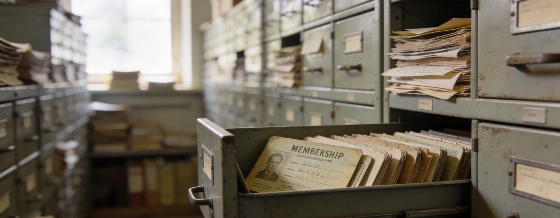
Millions of Nazi Party membership cards are now searchable online. Die Zeit’s AI-powered project lets users uncover hidden family histories. The database has drawn millions of searches and global attention.
Die Zeit’s recent project demonstrates how AI can transform inaccessible archives into high-traffic, public-facing resources. When the U.S. National Archives released digitized Nazi Party membership records, Die Zeit’s team saw an opportunity to make millions of scattered documents searchable for the first time.
Historically, verifying a relative’s Nazi Party membership required formal requests or in-person research at archives. The new digital release generated such intense public interest that the U.S. National Archives website briefly crashed. Die Zeit responded by assembling reporters, data journalists, and data scientists to build a searchable database from over 5,400 PDF files, each containing thousands of scanned membership cards.
The team relied on artificial intelligence, including Google’s Gemini LLM, to extract names, dates, occupations, and birthplaces from cards written in a mix of print and old German handwriting. Multiple OCR systems were combined to handle inconsistent formats and duplicate entries across two main card indexes. The result: a public tool that has enabled millions of users to search for family members and uncover long-hidden histories.
Die Zeit’s project also challenges misconceptions about Nazi Party membership. While military conscription was mandatory, joining the party itself was voluntary, though some professions faced social pressure. The database provides context on who joined, when, and how membership patterns shifted over time, revealing spikes after Adolf Hitler became chancellor and again when admissions reopened in 1937.
Accuracy was a key concern. The team balanced accessibility with the risk of AI-generated errors, allowing users to report mistakes and correcting hundreds of records. Some handwritten entries proved difficult to decipher, but AI tools handled most cases. The newsroom’s data science and AI desk led extraction and structuring, while visualization and history teams built the search interface and provided context.
Beyond search, Die Zeit analyzed membership trends, showing that civil servants and white-collar workers were overrepresented, while industrial workers often remained with other political groups. The data also showed a shift toward younger members during the war, many with backgrounds in Nazi youth organizations.
Since launch, the database has prompted users to revisit family histories, sometimes confirming suspicions, sometimes raising new questions. Even Die Zeit’s own staff discovered personal connections within the records. The project’s reach quickly expanded beyond Germany, with international media covering the tool and its impact on public understanding of the Nazi era.
Die Zeit continues to publish follow-up stories, focusing on user reactions and the historical context needed to interpret search results. The newsroom emphasizes that while a membership card confirms party enrollment, it cannot explain motives or individual actions. The database is positioned as a starting point for investigation, not a final judgment.