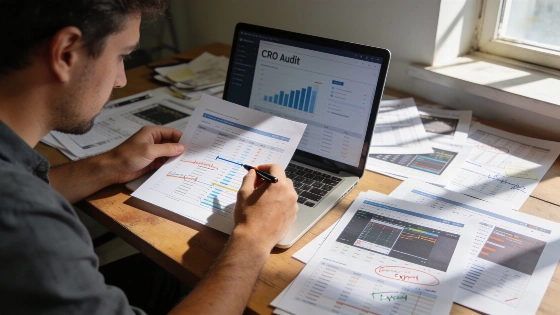
Claude can process conversion data in minutes, surfacing patterns that used to take hours to find. But speed comes with a catch: it’s easy for an AI-generated audit to look polished while missing the mark. A model might optimize for the wrong metric, misread a reporting period, or overlook a key business rule. The time savings are real, but so is the risk of convincing errors that slip through if no one checks the details.
In April and May 2026 alone, Anthropic aggregated data from approximately 250,000 Claude.ai and Claude Code conversations to study real-world professional use cases.
Defining success
Before uploading any files, teams need to agree on what counts as success. Is it a completed purchase, a qualified lead, or something deeper in the funnel? Claude will optimize for whatever metric it’s given-even if that metric is a noisy form_submit event full of spam. For ecommerce, a purchase is just the start; revenue per session, average order value, and refund rates can change the story. Lead gen sites face a different risk: more form fills don’t always mean more sales if quality isn’t tracked past the CRM.
Anthropic’s product positioning for Claude Sonnet emphasizes its suitability for high-volume, high-stakes professional workflows, including finance, research, and business operations. However, the company’s 2026 safety disclosures also document significant misuse cases, highlighting the need for rigorous human validation alongside AI-driven audits.
Evidence over assumptions
Claude’s output is only as good as the evidence it gets. Vague prompts like "audit this site" lead to generic advice. A focused evidence pack-CSV exports, annotated screenshots, and a one-page brief-lets the model work with real user behavior and business context. Exports create a fixed record, while Model Context Protocol (MCP) connections allow for live, segmented queries across GA4, Search Console, or CRM data. Each method has tradeoffs: exports are reproducible and safe, MCP allows deeper segmentation but needs strict access controls and human review.
Audit data shouldn’t be open to everyone. Read-only permissions, least-privilege access, and clear metric definitions are essential. Every query and recommendation needs to be checked, especially if Claude generated the logic. Saving the underlying data-screenshots, CSVs, or report links-gives strategists and clients a stable reference for every finding.
Tasking the model
Claude works best with clear, limited tasks. Instead of "run a CRO audit," ask it to triage landing page data, flag segments with real conversion differences, or pull validated findings into a table. For example, it can spot a high-traffic page with weak mobile conversion, but it can’t say why. There’s a difference between "the submit button appears below the fold on mobile" and "this causes low conversion"-one is an observation, the other is a guess.
Human review is the final check. Every finding needs to pass a few tests: does the event reflect the real outcome, is tracking reliable, is the sample size big enough, and does the page actually behave as expected on real devices? Even a big drop in conversions can be a mirage if tags break or sampling skews the numbers. Only after these checks should a recommendation move forward.
From findings to action
Once findings are validated, they form the backbone of a test plan. Each recommendation should list the affected page, supporting evidence, expected behavior change, hypothesis, main and guardrail metrics, confidence level, and implementation effort. Claude can draft this structure, but the strategist decides what’s worth testing and what needs more digging. Scoring must stay transparent-no black-box "priority scores" from the model.
Speed is the main advantage. Claude can cut hours of manual sorting down to minutes, letting strategists focus on diagnosis and prioritization. But letting AI "run the audit" is risky. Without strict briefs, controlled data access, and constant human checks, the risk of false positives and wasted tests goes up fast. As recent reporting shows, AI-driven audits can backfire when governance fails and unchecked outputs reach clients.
Anthropic’s own safety reporting in September 2026 showed that Claude had been used in misuse cases, including cyber operations, influence campaigns, and fraud. This highlights why human oversight is needed to prevent harmful or misleading outputs. According to Reuters, Anthropic has removed accounts involved in influence operations, such as three Iranian state-aligned accounts, as part of its ongoing enforcement. These cases reinforce why AI-generated audits must be checked before delivery, especially in high-stakes business settings.
AI is now a force multiplier for CRO audits, but only for teams disciplined enough to set the rules and enforce them. Claude can organize, triage, and draft, but it can’t replace the strategist’s judgment or the business context that turns data into action. The teams that benefit most will be those who use AI to speed up the grunt work-while keeping interpretation, prioritization, and final recommendations firmly in human hands.
Anthropic’s Claude, launched in 2023, has quickly gained traction among digital marketers and analytics teams. By 2026, the platform is estimated to process millions of audit-related queries each month, with enterprise adoption driven by its integration with GA4, Search Console, and major CRM systems. Despite its speed, industry surveys show that over 70% of CRO professionals still require human review before accepting AI-generated findings, underscoring the ongoing need for expert oversight in high-stakes optimization work.